

Mass readings for the 19th Sunday in Ordinary Time:
1 Kings 19.9, 11-13 Psalm 85.8ab & 9, 10-13 Romans 9.1-5 Matthew 14.22-33
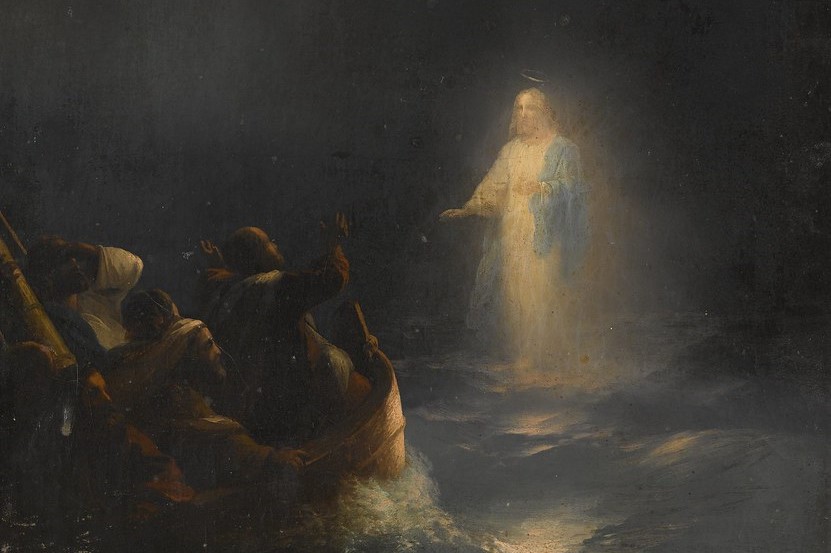
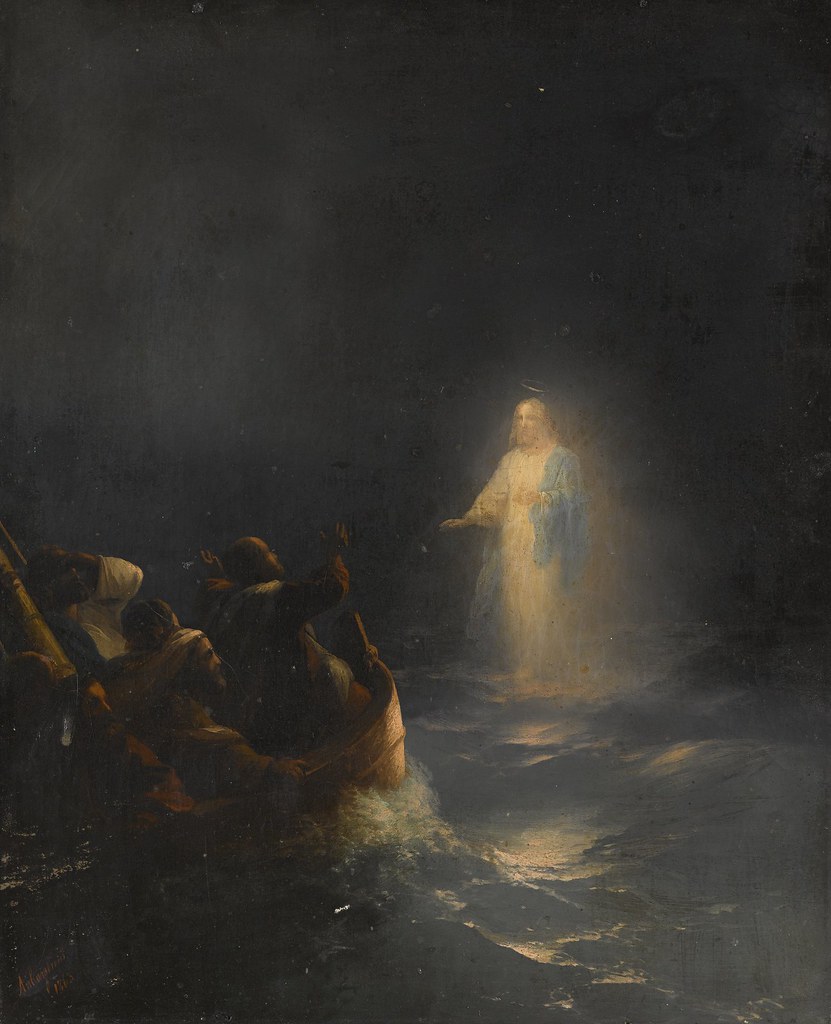
Everyone, christians and non-christians know Jesus walked on water. Or should I say, that it is claimed that he did. Do you believe he did? Do I? A difficult question because for the modern mind, the answer isn’t straightforward. And well, that is the kind of mind we all possess inevitably as people of the modern age.
The Church affirms the reality of the miraculous. We investigate claims to sainthood on that basis, and we acknowledge, through exhaustive verification, that Our Lady has made appearances among us, that Eucharistic miracles occur. And even in my own pastoral practice, there are what we might call “minor” miracles that I’ve come across – signs, healings, personal epiphanies that I cannot attribute to my own imagination. So, did Jesus walk on the water? Yes, is my answer, but believing it is still a challenge. And it’s good to admit that.
Now, if you’d gone to school in a Western country in the last hundred years for your basic education, in your history classes you likely touched on the topic of the Enlightenment – a period in European history from the late 17th to the late 18th centuries. Names like Rousseau, Voltaire, Goethe, Hume, are likely in a back corner of your memory as a result. It was at this time that the ideas of empiricism, rationalism, the primacy of scientific knowledge, with particular reference to divine revelation, was posited and then pushed by the revolutionary movements that overtook the Christian societies of Europe, what was Christendom but what we now call Western Civilization. This was presented in the classroom in a positive way with little if any critical assessment. After all, isn’t being enlightened a good thing? But, of course, to accept the Enlightenment as a stage in humanity’s progress toward some ultimate perfection, implies that prior to it was darkness, ignorance and superstition. Christianity, inescapably, is implicated in that darkness, and the upshot of it all was that stories of miracles and fantastic occurrences that we find in the scriptures become… what’s the modern word for it? Problematic. And the problem for us is that we are now of two minds on such things.
This leads to two approaches to scripture: one, championed by no less a figure than Thomas Jefferson was to remove all the supernatural occurrences from the biblical text – Jefferson actually took scissors to his Bible. The effect of that is to make of Jesus less a Messiah and more a philosopher, not a Saviour but a sage – and so, he’s not that much use to us beyond some good advice. That is a perspective of many, even Christians, and often its quite unconscious. They admire the man Jesus, but as to true faith, that is suspect.
The other, found within Christian circles, is to take a literary approach to the text. It’s one we’re familiar with from hearing decades worth of homilies. Effectively then, we treat such stories as we have today as fiction, more accurately, as myths, but without saying as much. After all, we don’t want the scriptures associated with mythologies like those of the Greeks and Romans. If you remember your unit in English class on classical mythology, the way we were taught to read myths about the Olympian gods was to not ask “did it happen?” but focus on “what does it mean?” That’s because it was clear that these stories were meant to explain things found in the world, important events, to explain natural phenomena, like where the Sun goes at night. But what is taught at the secondary school level is very selective – we do the easy ones in high school, those with straightforward meanings and safe moral lessons. Study further, and ancient mythologies grow quite opaque in terms of their intelligibility. That is, they really don’t make sense as a system that explains the big questions of existence. If you know them, they certainly are no guide to morality.
Treating stories about Jesus this way, however, is an error of category – they don’t belong with the stories about Icarus, Theseus and Hercules. Besides, a story such as we have today has an obvious interpretation that really begs the question, why would the gospel writer bother with it? When tested, where is our faith? The question being put to us, will we do better than Peter who manages a few steps then sink? If that’s the case, there are enough non-miraculous episodes in the gospels, the later betrayals we see in the story of the Passion especially, to emphasize the frailty of human faith.
But if this is something that the disciples actually experienced, it answers the question a lot of us urgently ask of the gospels: in the difficult times of my life; will God actually come to me?
We pretty quickly know when we are hearing a myth, whether within the Bible, or from another culture. It’s clear a very old story is being preserved from a time when there was no writing and it had to be passed down orally through time. In the case of the epic poems of Homer, the Iliad and the Odyssey, these concern events that transpired 1200 years before the poet’s birth. It is obvious that over the long centuries there were embellishments and errors compounding as the tale was passed down generation to generation.
In our modern times, we do have something called an urban myth, and we get invented stories about real people, but far more often than not they get debunked pretty quickly. Living witnesses are around who can nullify the fictions and verify the true stories.
In the case of Jesus’ walking on the water, St. John was most certainly still alive when Matthew and Mark’s gospels first went into circulation. John was attending gatherings of Christians where he would either hear this story, or he shared it himself (after all, his gospel has a version of it).
So, why do we know this extraordinary story? Why is it important that we know it?
The designers of the lectionary, the cycle of readings we have from week to week, shed some light on this with their choice for our first reading. And they are telling us that what the Church wants us to know, aside from our interpretations of events, how we might parse an episode from the gospels and draw lessons from it, is that God does comes to his people in time of need.
We started with the story of the prophet Elijah, alone, on the run, tired and afraid, hiding in a cave up a mountain. There is a terrifying storm that we’re told literally is causing the mountain to crack, to split, rocks are shattering. But God tells Elijah to stand at the mouth of the cave, exposed. I’ve been in some frightening storms. I still remember being caught in one hiking in the Pyrenees mountains, and finding shelter in a rural bus stop. I will never forget how the thunder boomed around me, how lightning struck across the road from me. Now in all that natural violence, no rocks exploded. But we’re told in our scriptures, this is what Elijah experienced. And why so extraordinarily violent? God is showing him that despite all that violence of nature, and of course, despite the fact that evil King Ahab is after him, God is with the prophet; and he will be okay. And the story, for me, has the ring of truth because of the manner in which God is manifest to the frightened man. We know how God has appeared dramatically to others, to Abraham, and Jacob, and Moses, to have three examples. But in Elijah’s case, it is in stillness and silence that God is known. What a special lesson for the spiritually and physically embattled man on the mountain top! But it’s a lesson for us too. Yet only one we take seriously if the story is true.
If we carefully read the gospel story today, we note that Jesus tells the disciples to go on without him, to get into the boat and cross to the other side despite it being late. Most of the twelve were fishermen, who knew the lake of Galilee, knew the risks of a night passage. They nonetheless went. We also need to remember, that in terms of the chronology of the gospel, this is after the time the storm came up with Jesus in the boat, when he stood up in the bow and ordered the winds to calm. So, they’ve had that experience of his power, but now, they won’t have Jesus with them. As with Elijah, this is a demonstration of God’s care for us; that while we may find ourselves frightened, discouraged, and we feel alone, bereft of God, he will come. But it only is convincing if the story is something more than myth, more than a fanciful, pious tale.
And the story rings true in that the Apostles in the boat aren’t in any immediate danger, but they are in difficulty. They are struggling against the wind, are making no progress, are likely getting very tired and wondering why they are doing this in the first place. And then here Christ comes across waves. What a bizarre sight!
I won’t retell my own story of being in a storm out on Lake Ontario as a twelve-year-old boy. What I will say is that I remember it in considerable, in some moments of memory granular, detail. And I wish that for all that I came through, it changed my life in the very instance. But that actually took a lot longer. Later I would draw lessons from it, later I could see its importance. I’m certain many of you have had similar occurrences. These are things remembered, and we draw lessons from them through revisiting them. So, how then can we doubt St. John or St. Matthew, that as incredible as this might seem to us, that what they say happened to them, indeed happened?
It’s important that it happened, however it may have happened. Important for what it taught the disciples who would only really take in its lesson in later years; important for us, who will also find ourselves caught up in storms or simply struggling against the wind, in need of a saviour to come to our aid.
Christ comes, he really does, across the waves, through the storm, he comes.
Amen.