

Mass readings for the 25th Sunday in Ordinary Time:
Isaiah 55.6-9 Psalm 145.2-3, 8-9, 17-18 Philippians 1.20-24, 27 Matthew 20.1-16
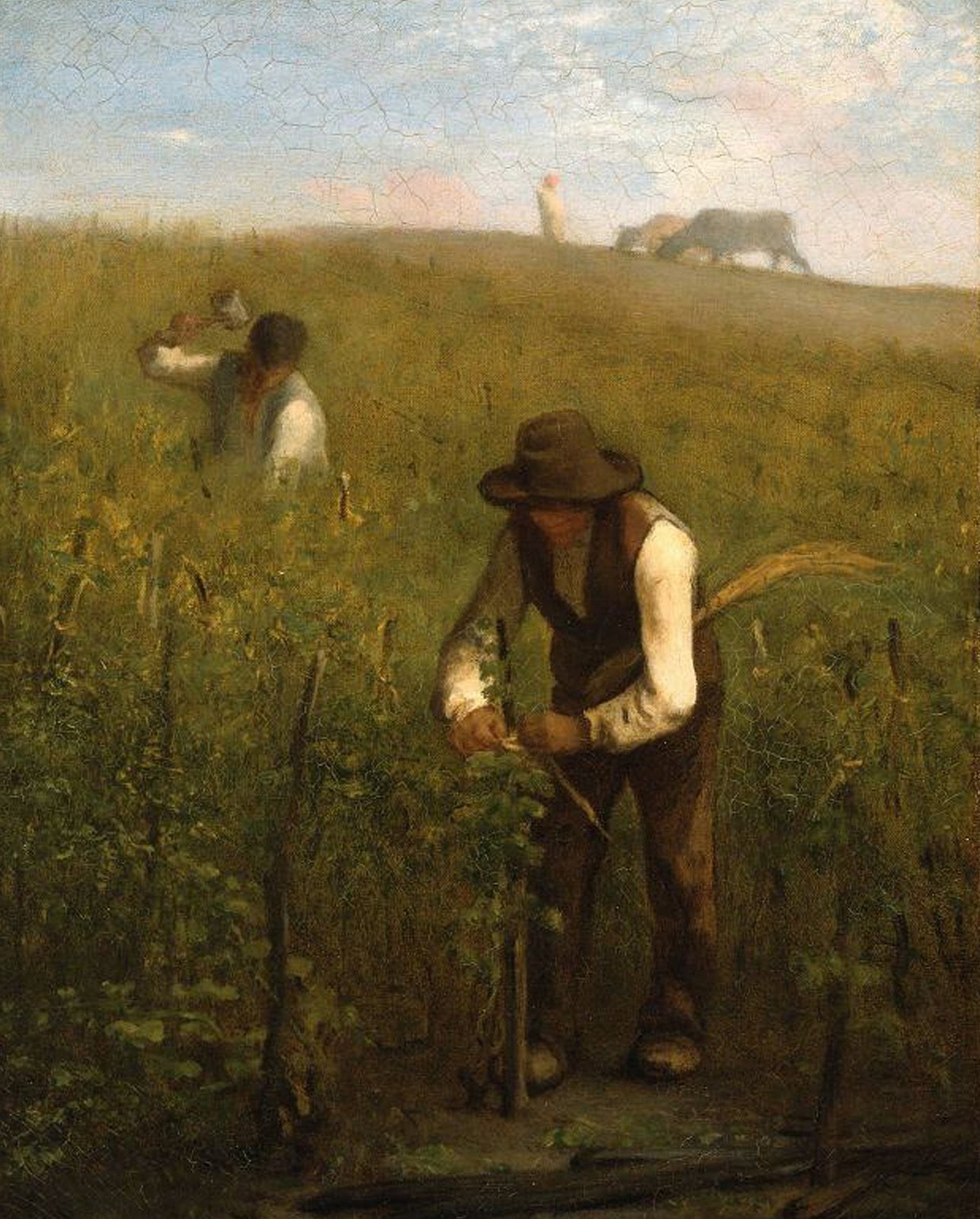
Jesus’ parable of the workers in the vineyard offends our economic sensibilities: the characters within the story reflect this. Everyone getting paid the same regardless of the hours they work would end in a riot just about anywhere on this earth. We have a sense of just recompense, whether that is in seeing someone underpaid, doing a full day’s work and not earning enough to look after themselves and their family, or in some celebrity, elite athlete or corporate CEO being lavishly paid well beyond any reasonable sense of value.
Now these injustices are not what Jesus is addressing. Rather, he is teaching us about the economy of salvation, and we can only thank God that this is how it works – that we don’t earn heaven. Rather, we accept it. That offer of a job in the vineyard today is an admission into God’s kingdom. We start by working in the fields of the Lord with the prospect of resting later at his house, in the good company of others, with food and wine, music and camaraderie. But we first have to take the job. Having spent a day myself working in a family vineyard in Croatia, I can tell you, it’s hard work.
When the clergy gathered earlier this month, we had a presentation on what was referred to as “the lost sheep.” The group identified by demographers as lapsed Catholics, were they a Christian denomination, outnumber any other single Christian denomination active in worship and service in the Western World, including the Catholic Church. Just looking around us here, we know that not everyone is coming. The estimate for Canada is that 1 in 5 Catholics regularly comes to Mass, financially support their parish, do some volunteer service in the name of their faith community.
The presenters were from the Catholic Leadership Institute. What they had to say in terms of these kinds of statistics was nothing new. I’ve been seeing these numbers for as long as I’ve been an active Christian, as a Protestant minister and as a Catholic priest. What I’ve wanted is some constructive way of addressing this. And what we heard on this recent occasion was a little more detail to help us figure out what is going on with all these people. In terms of our Lord’s metaphor of idlers in the town square seeming to be looking for work, it was insight into why they aren’t accepting the job offer of Christ. And the problem was examined both from the perspective of those milling around in the square, but also examined those doing the recruiting, that is, the Church.
And the first thing for us to realize is that the current Church is not built to purpose, and its culture, the way we think about it does not reflect the reality in which we find ourselves. Now, again, I’ve been hearing this for as long as I’ve been in ministry. The Western World, Canada, is now a mission field.
The Church has subsisted within two broad historical frameworks: Christendom and the Apostolic Age. I think we know what Christendom is: society is thoroughly Christian even if individuals aren’t particularly. The faith is openly professed and celebrated publicly, civilly, that is political leaders are glad to associate themselves not only with Church leadership, but with Christ himself, anxious to have everyone know they too are disciples and that, indeed, all should come to Christ. The Church is then in maintenance mode. The priests dispense the sacraments, the schools do the catechesis, the Catholic hospitals and social service agencies support those in need, demonstrating the compassion and care expected of every Christian.
Yet there are also “apostolic” times. The first apostolic age, of course, was the early Church that labored under persecution, often violent, yet struggled to establish herself and set up a structure of support for those keeping the faith in the face of a hostile culture. Such an age is not a once and done thing. We fall back into such an era whenever we, or our rulers, grow complacent, and frankly, presume upon God’s grace and favor such that there is neglect of the rituals, flouting of the teaching, and even mockery of the sacred. And we’re there again.
But what is important is how we, the faithful, respond. And for one, as per our Lord’s parable, we have to go down to the marketplace, to that town square, and begin calling out for workers for the vineyard, and to do this through the whole day long.
Who will we find there?
The institute presentation broke this down into sub-categories of the lapsed. The two biggest groups were those identified as “cultural” Catholics. That is, they still come to mass from time to time; but they’ve always got one foot out the door. They’re not really hostile to the idea of faith, it’s just they’ve never had really had it. And in large part it is because of how they’ve been taught, the expectations that were created in them. Oddly enough, too little was expected of them, and in turn, they were taught not to expect much of the Church, her liturgy, her fellowship, her service. And that conditioned them to also expect little of Christ himself. From the perspective of those who know Christ, despite the failings of the Church, we see that these folks don’t know what they are missing. But how then do we make what is on offer known?
The other big group among the lapsed were called “the shruggers” and they are the truly apathetic. Were we to set them in the town square of Jesus’ parable, they would be on their phones, doomscrolling. I know that is anachronistic in terms of Jesus’ story, but that reflects the uniqueness of their situation. In the ancient world, people believed… that is, they believed in something beyond themselves, often in error, following superstitions, joining cults and religions as the fashions changed, but they appreciated the concept, known in 12-step programs, of “the higher power.” Today, we find so many who never think about the eternal, their souls, heaven or hell. They exist in what is described as “open-minded lethargy.” And their spiritual tepidness is reflected in a generalized apathy that we see in so many who are resigned to the world as it is, keep their heads down, and hope to get through life without too much suffering. And that’s so sad! We need to help them understand what is at stake: fullness of life, and not what is effectively a living death. Christianity is either the most important thing they’ve ever encountered, or that it is indeed false, but they avoid recognizing what that means for them. It means a choice that should be made consciously and with full appreciation of its consequences for them and for their families and our society: meaningless existence without true direction aside from what might be arbitrarily chosen for us by our leaders; or a truth that illuminates the world and makes our choices anything but arbitrary, but profoundly meaningful. And if it has meaning, purpose, direction, it is directing us toward something, someone. And that’s someone we need to introduce to them, the lapsed, the cultural Catholic, the shrugger, the spiritual but not religious, the moralizing wokester, the skeptic, etc.
And we need to do that soon. The day’s not done, we still have trips to make to the town square, the Lord needs workers for the vineyard, but even more we need to save the people we know and love, and those we don’t know, and maybe don’t even particularly like. Yet in earnest faith, out of the love we’re called to live in, we’ll be happy to be the last among a multitude of the saved. Amen.