Mass readings for the 29th Sunday in Ordinary Time:
Isaiah 45.1-4-6 Psalm 96.1 & 3-5, 7-9 1 Thessalonians 1.1-5ab Matthew 22.15-21
Politics is the religion of the western world. Such is the sad truth of our times. It’s happened before to societies and civilizations – they invert the proper order of things (it’s the biblical story of Israel): God first, and then society ordered to Him then becoming a society that makes religion serve its political priorities; or indeed, as we see today, dispensing with God and religion as an inconvenience to its plans, relegating these to the private lives of the people. But this does not eliminate what we know as the religious impulse—the very real need we have as both individuals and as societies for faith in something.
This inversion isn’t always recognized as its happening – we arrive at it, either by apathy or revolution; or a combination of the two. That is, we see the forces working to overthrow the proper order, but lacking leadership, we don’t know how to respond or we react ineffectually, half-heartedly, and actually accelerate the revolution. And so, here we are.
Human beings slip into this apostasy with regularity, but especially their rulers and leaders (again, we can refer to Israel’s kings, but history is filled with examples). They forget to foster and encourage the true human vocation of seeking holiness and communion with what is eternal, and instead wanting power they look to provide the immediate satisfactions the passing world can give us. For the ambitious this is usually direct exercise of power over others, wealth and fame. For most of the rest of us, it’s security, entertainment and a full belly we want. Ironically, with God they and we enjoy all these things; without him, they all quickly disappear.
We know politics is our religion, as opposed to a true faith, by how much people bring up politics in their conversation even as they aren’t really prepared to discuss it. Politics, even if we don’t understand what’s going on, engages us because of our anxieties about our personal material well-being; those who appear to threaten it, and those who claim they can protect us from the threat. God is displaced by politicians, parties, ideologies and elections as the remedy for our worldly worries as we forget about our eternal souls.
What is so disturbing is that politics, as a faith, is a heresy that possesses so many who think themselves Catholic, and Christian, let alone the many who have no religious affiliation.
The Church in her many statements, in the encyclicals of popes (examples: Mirari Vos – 1832; Rerum Novarum – 1931), have warned against the modern ideologies that have possessed the Western world, both liberalism and socialism—these are the Scylla and Charybdis between which the faithful must navigate, either of them being a trap that will doom us. Like the seductive songs of the sirens of Greek myth, we are seduced by the promises of plenty for all, that are empty of any spiritual concern, and so doom those who draw too near. Modern political ideologies appeal because they perform the psychological function of religion, providing answers to fundamental existential questions, offer a framework for salvation, albeit a redemption in this world, in this life rather than in the next and for eternity.
I can’t tell you how often I encounter folks, strangers and those I know alike, who can’t help themselves and launch into a political diatribe, even before we exchange the customary pleasantries. Earlier this year I related in a homily an encounter I had on my first winter vacation in seven years – the lady in the lounger next to me insisted on sharing all her political opinions and then interrogating mine. I did my best to deflect until my dear wife rescued me. By the time I returned, the lady was gone, and I could only conclude that I had proved unworthy of her company—a failure to immediately agree with and so endorse her opinions is all the proof she needed.
If we could go back to the 5th century, and to Constantinople, we would experience a dramatic contrast with today. Then, according to many accounts of travelers to the great city that was effectively the capital of the Christian world (apologies to Rome), we would have found everyone, from fishmonger to senator, laundress to lady in waiting of the Imperial court, quite ready and eager to share their opinions on the nature of the Holy Trinity, the status of Mary, the matter of the Father and the Son being consubstantial, etc. That is, what was top of mind were things being discussed in the great councils of the Church. In the popular mind, and not just in the rarified atmosphere of seminary and academy, these were important matters. People seemed to understand: get God right, and all else will follow properly. Get God wrong, and so much else will go wrong.
Jesus came to make sure we get God right, and order our lives in a way we can live them well.
What we see in today’s gospel story is the coming together of a coalition of disparate parties, factions that competed against each other for power now making common cause against Jesus. They are afraid that if he’s not stopped, he will win the power they’re all after; and they don’t believe that he’s not interested in power. They are trapped in what today we call a “bubble” and the only perspectives they have are those in that bubble with them; everything is politics and the prize is always power. So, they either can’t believe that Jesus is not like them, a cynical politician at heart, or worse, he is a naïve political dilettante who is going to spoil the game for everyone else.
They ask a question about taxation. It’s really a trap, but it turns out instead to be a test that Jesus passes, and they fail. We know there’s no good answer: if Jesus says yes to paying taxes, he’s a Roman collaborator and so, discredited as the Messiah. If he says no, they’ll inform the Romans that he’s a rebel knowing how well the Romans deal with troublemakers.
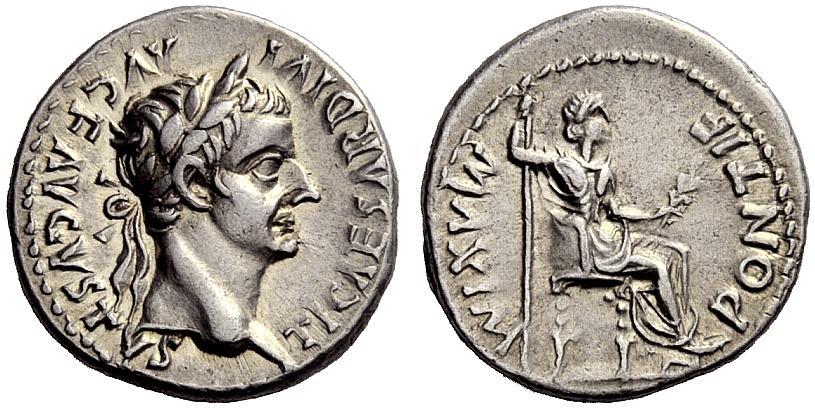
Jesus is so clever! His answer becomes a test of his interrogators. He first asks to see the coin with which the tax is to be paid; that is a Roman coin bearing the image of the emperor. Surprisingly, one is produced and we have to wonder how it is that these scrupulous, pious men would have on them the coin of idolatry, the money of the despised empire while within the precincts of the Holy City and the Temple? Is this not just the kind of pollution they claim to be their great concern?
Then Jesus tells us that whatever bears the image of a person, his icon, rightly belongs to that person. So, the coin belongs to the Emperor Tiberius. But anyone familiar with their scripture will know whose image and likeness all humanity is made in: its God’s. Therefore, we belong to God. And so, we have that proper ordering of society. Yes, we have our kings and presidents and prime ministers, and there are those things which we might owe them in terms of national loyalty and law, but all of that must be ordered toward God. And if it isn’t, we are nonetheless to remain ordered toward God—no matter what. Now, that could have been taken to the Romans as proof of Jesus’ sedition, but one can imagine how impatient Pontius Pilate or any other Roman magistrate would have been in listening to these scribes, lawyers, Pharisees and Herodians explain the theology of it all.
So, does this mean that Christians are to be indifferent to politics; to pay no mind to the incompetence, corruption, sinfulness that might be rife among those who govern us?
Not indifferent, but discerning. And not discerning as the world wants us, but meditating upon such things according to the mind of God.
Consider the first reading from the prophet Isaiah. We hear it in English, but the first Christians would have heard it in the Greek of the Septuagint, the popular translation of the Hebrew scriptures into the commonly spoken language of the time, Greek. The first line of that passage concerned the Emperor of Persia, it says, “Thus says the Lord to his anointed, to Cyrus, whose right hand I have grasped to subdue nations before him…” Cyrus is God’s anointed, and so, our spiritual ancestors would have heard it said that Cyrus is a Christ. We know that he is not a Christ in the same way Jesus, the only son, is the Christ; he is more a Christ in the sense that all of us have been anointed, Christened, and so commissioned to work for our Lord. In the case of the Persian Emperor, Cyrus would have been entirely ignorant of God’s designating him a Messiah; and yet, he is the one who ended the Babylonian Exile and allowed the Temple to be rebuilt, the sacrifices to begin again, the people of Judea to again be taught the faith.
This is a lesson in theological perspective on the world of politics and power: who knows how the will of God will manifest itself, and through whom. In this we must carefully discern as we look into the world of politics and power. That is, we don’t interpret things according to the framework of modern politics – the pundits on the t.v. news panels talk politics, rarely ever faith and values; they speculate on the contest for power; do they ever discuss our spiritual mandate as a national community?
As was explained in the Vatican II constitution finalized in 1965, Gaudium et Spes, that is “Joys and Hopes”, the mission of the Church does not relate to the political, economic or social order; rather her purpose belongs to the religious order. Out of this comes the task of structuring and consolidating the human community according to divine law (GS, 42). That is, in the words of St. John Paul II, “to bring about a civilization of love” (Dominum et vivificantem, 81). Through our faithful and faith-filled activity, Christ will illumine human society with his saving light (Lumen Gentium, 36).
What a better thing to make an obsession of, to make part of our daily conversation, to be the topic of conversation into which we invite others. How can we make this world a reflection of the love of God through how we live, work, play and worship?
The world sets for us traps, posing questions that present a false choice, offering answers that are no solution to our dilemma. But such is the coin of this world, money that cannot buy us our freedom. We know in whose image we are made, and to God we belong. We are, to paraphrase the great saint and martyr, St. Thomas More, the good servants of our respective nations and states, but God’s first; and for the soul of our country and those of its people we labour.
Amen.