

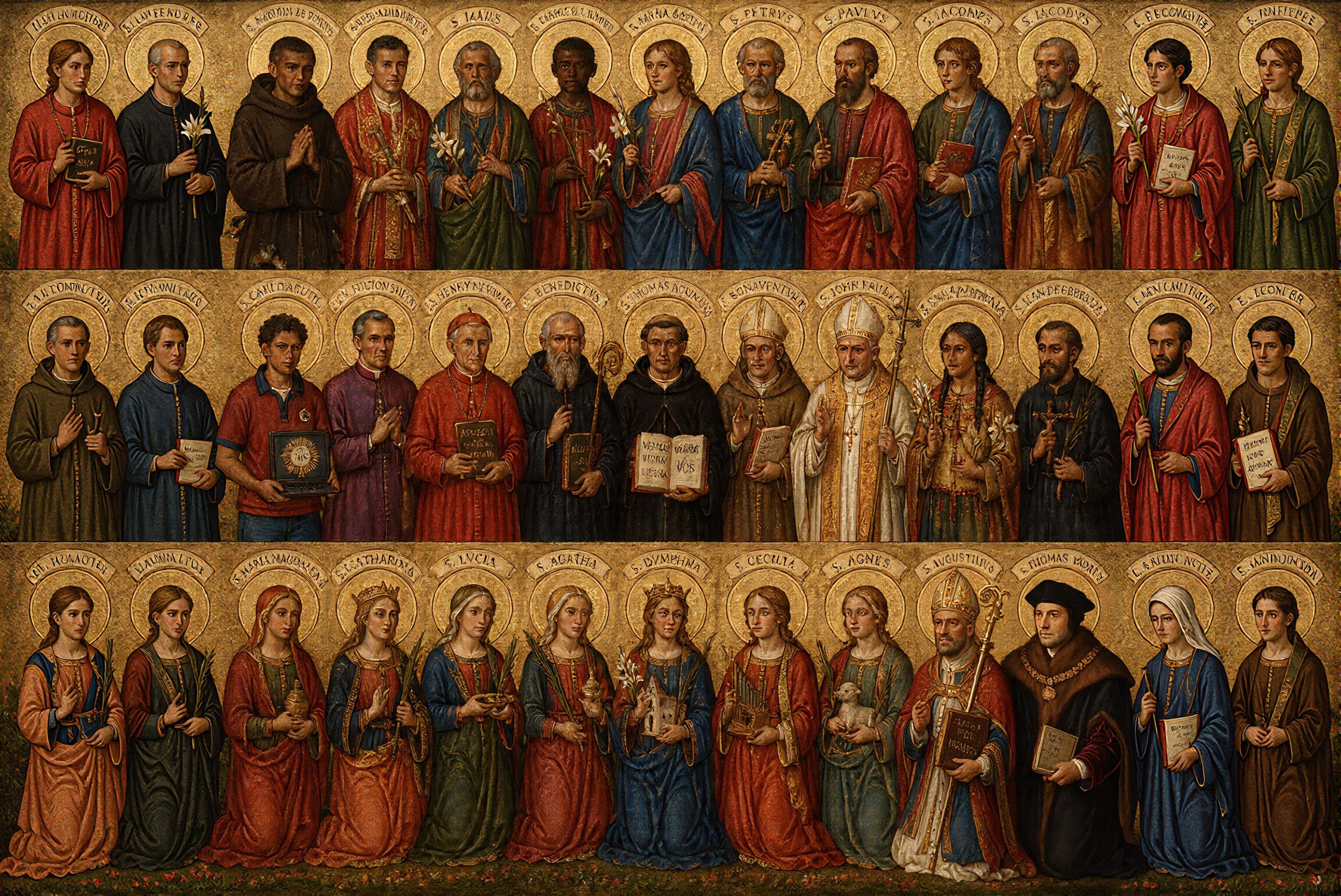
Mass readings for the Solemnity of All Saints:
Revelation 7.2-4, 9-14 Psalm 24 1 John 3.1-3 Matthew 5.1-12a
The Beatific Vision is what the saints in heaven see. As they stand in the presence of God, as sketched for us in that first reading from Revelation, they have this unmediated sight that produces pure joy. This prompts them to respond, as we hear in the passage, “Salvation belongs to our God who is seated on the throne, and to the Lamb.” It’s the vision of our salvation.
As we gather in remembrance of our beloved dead, a month of remembrance beginning with the Feast of All Saints, continuing Monday with All Souls, and then through the month we are encouraged to visit the graves, the tombs, the resting places, to offer acts of remembrance in prayer, our hope is that they are standing amidst that great multitude in a state of complete joy.
But what of the living of this mortal existence? The people in our lives, who we may see every day, or with whom we have some regular contact, do we pray for them with the same intention, the same intensity, with the same hope that, indeed, they will see God face-to-face?
Heavens, is that even our own personal prayer for ourselves? Have we remembered what our aim is in this life and how it relates to the next? What is it that is informing our lives right now? The ultimate goal? Or something much less? Is the happiness we seek bound up in this world? Do we understand that the fullness of joy that Jesus speaks of – remember he wants us to have his joy in our lives and that the joy be complete – or have too many allowed their imaginations to be so truncated by our culture so as to find heaven entirely unimaginable, and so, really no longer a consideration in how we live day to day?
The Dicastery for the Defense of the Faith, one of the offices of the Church headquartered at the Vatican, produced a report recently, entitled Venite Ad Me; that is, in English, “come to me.” It is something of a compendium of reports from bishops’ conferences around the world, papal encyclicals, etc. all speaking about the problems of evangelization, the dysfunctional culture, but with a particular concern over the handing down of the faith. Indeed, it states at its outset that it is intended primarily to stimulate our reflection and commitment regarding the transmission of the faith. It observes, however, that at this moment the faith is not being passed on.
Citing a report from the United States Conference of Catholic Bishops, the document says the faithful “tend to be more absorbed in culture than in faith. Culture, through social media and public discourse, in turn shapes how Catholics think more than Catholic faith, tradition, and devotion do.”
Pope Francis identified the heart of the matter as being the radical individualism of the current culture and wrote and spoke of this on multiple occasions saying that this principally consists in the exaltation of the “sovereignty of the self” – we are our own Lord, not Christ. It’s an assertion of autonomy and freedom to determine every aspect of our own existence, subjecting other human beings and the surrounding reality to our needs as we define them. “This trend reflects the spread of an increasingly pronounced individualism, which generates separation, division, envy, jealousy, domination, narcissism, and worship of the self.” (Venite 56)
What we should be looking to as a means of defining our proper needs is not the popular culture, but rather what our Lord and Saviour directs us to consider in today’s gospel reading: the beatitudes.
When Jesus preaches the beatitudes with all their “blessed are’s”, he’s actually offering a similar if muted revelation of that same beatific vision we read and hear of from the Book of Revelation. The beatific vision relates to the beatitudes in their common Latin derivation: beatus, which means “happy” or “blessed.” So, the beatific vision is literally a “happy sight” something seen that makes us happy. Beatitudes are then those things that bring a kind of happiness in this world, but also afford us a glimpse of heaven and a momentary experience of divine joy. As our Lord tells us he will give us joy, but not as the world gives, and so, this happiness, this blessedness is otherworldly. It’s a happiness that we might experience in our darker days more as hopefulness. It’s the smile we can make in the rain, the laughter in the soaking downpour.
But if the beatific vision is essentially seeing the face of God, how can these beatitudes be related to that? Jesus is talking about people not God. Well, this is what we mean when we talk about participating in the life of God – virtuous people doing good things: being of service to others, fighting for justice, negotiating for peace, working to purify themselves of sin in their own personal lives. In our Christian understanding, these are not examples of human accomplishment per se; but rather they are instances of God working through us – the scriptures are clear: we do nothing good apart from God. So, when we see one of these virtues lived in another, when we practice them ourselves, that is when we can catch a glimpse of what the saints see full on. It makes God familiar in a way, for all his mystery, his otherness, we come to know him a little better and trust him a bit more, furthering our giving of ourselves to him, less in fear and more in confidence.
I’ve been reading a biography of Saint Elizabeth Ann Seton. She was a convert like myself from Anglicanism to Catholicism. The through-line of her life was this idea of eternity; specifically, eternity with God, in his presence, but then too, in the presence of all whom she loved. Through all the travails of her life, as a society wife, mother of five, then later as a young widow, a woman sadly outliving three of her children, as the founder of a religious community, as a faith community leader overwhelmed by her responsibilities, as someone who had to contend with her own declining health, she renewed herself with that sense of the eternity to which we are called to in Christ.
I can’t help but wonder where that sensibility has gone as I look at a world so caught up in its current discontent that it has lost the perspective of eternity and so, looks to immediate satisfactions, either in destroying what it sees, or desperately clinging to what it has. In both instances the selfishness, undue self-regard, the grasping after power, the disturbingly demonic plans now publicly expressed concerning how each side in the many conflicts will deal with enemies through violence, repression, confiscation of property, deprivation of liberty. It all brings me to long for the beatific vision in place of what the screens on our devices show us: the diabolic vision.
In these days of crisis, economic crisis, civilizational crisis, spiritual crisis, we must renew our vision of what we are about: the vision that inspires us. Saint Elizabeth Ann Seton once wrote a friend who was in some distress, telling her, “Eternity… think of it when you are pushed hard—Pray and praise and bless and adore forever.”
By her aspirations to eternity, she was in turn inspired in her service, in her prayer, in her following the example of the saints and in turn, being an example for others. So, today, let’s be inspired, and so aspire to the vision that awaits us, and look to see some of it here and now, in our lives pursuing saintliness, together and forever.
Amen.