Mass readings for the 30th Sunday in Ordinary Time:
Exodus 22.21-27 Psalm 18.1-3, 6b, 46&50ab 1 Thessalonians 1.5c-10 Matthew 22.34-40
The question of the greatest commandment comes up in the gospels of Matthew, Mark, and Luke. In Mark it’s presented as perhaps a sincere inquiry. However, in Matthew (who we hear today) and Luke, it is a test. That is, the matter does not come up in an honest discussion. It’s part of a bigger argument Jesus has with the establishment, the Pharisees, the lawyers and scribes. He’s asked about the greatest commandment to corner him, just as previous questions about marriage, taxation and the idea of resurrection weren’t about finding the truth, but were aimed at discrediting our Lord.
In Judaism then, as now, the Torah as a legal code has 613 laws to be kept by the faithful Jewish person. Which of these is the greatest? Which of them is to have priority in circumstances where there might be an apparent conflict between two laws? In modern civil constitutions and legal codes this happens, and supreme courts then determine which laws, or rights, have precedence.
But here Jesus refuses to answer the question in these terms, to offer an ordering of the law by priority. Instead, his answer is to give us an interpretive key to be used with every law: whatever the particular law is, it must be seen through the lens of love of God and of neighbour, and of self. The reason the laws are there in the first place is to enable love of God and love of neighbor.
We can see how this has not been understood, even among today’s Christians, be they devout or merely nominal. Indeed, many nominal Christians dominate public debate in their assertion that compassion and empathy are synonymous with Christianity and so, abrogate natural and moral law. I’ve spoken of suicidal empathy before, the impulse to compassion that permits oneself and one’s society to be victimized in the cause of justice, equity, tolerance, etc. Those who push back against foolish policies that permit evil (ironically in the name of justice and fairness) are dismissed as cold-hearted moralists, even as bigots for having qualms over how far compassion ought to extend to those who cause harm in our society.
So, the love of God and neighbour should not be taken as stand-alone divine legislation. Rather it exists in relation to natural law, to moral law. Those latter laws must be kept, lest we descend into chaos, sin and death as societies and as individuals. We cannot love God and steal, lie, and murder as individual persons, nor as a civilization. The contradiction will bring about a social and political implosion; and we’re seeing a lot of that.
Recent events in France have insisted themselves upon our thoughts. What is going on? If ever we could find a place lacking in love of neighbor, it is that sadly benighted land. France, once called the first daughter of the Church, is falling apart. To try to attribute what has happened to one cause, as so many in the media have tried to do, is to be naïve.
Yes, their public education system is faltering, but not for lack of funding (spending per capita is above the European average, the same as Canada’s) Yes, their economy is stagnant despite all kinds of attempts to stimulate it through public spending, and immigration. Yes, as a result, they’ve a massive public debt that is reaching the point of being beyond repayment. They’ve now a large unintegrated community of North African Muslims whose resentments have boiled over, but whose own religious and cultural militancy has certainly contributed to the problem. Yes, they have an affordability crisis. Yes, they have alienated their youth who despair of ever having a decent life in their native land. Yes, they’ve created anxieties among the older demographic whose public pensions and private investments are threatened by the unrest in the country. I won’t go on, save to observe that these problems are common to the whole of Western civilization and add there appears no one who knows the way out of the mess.
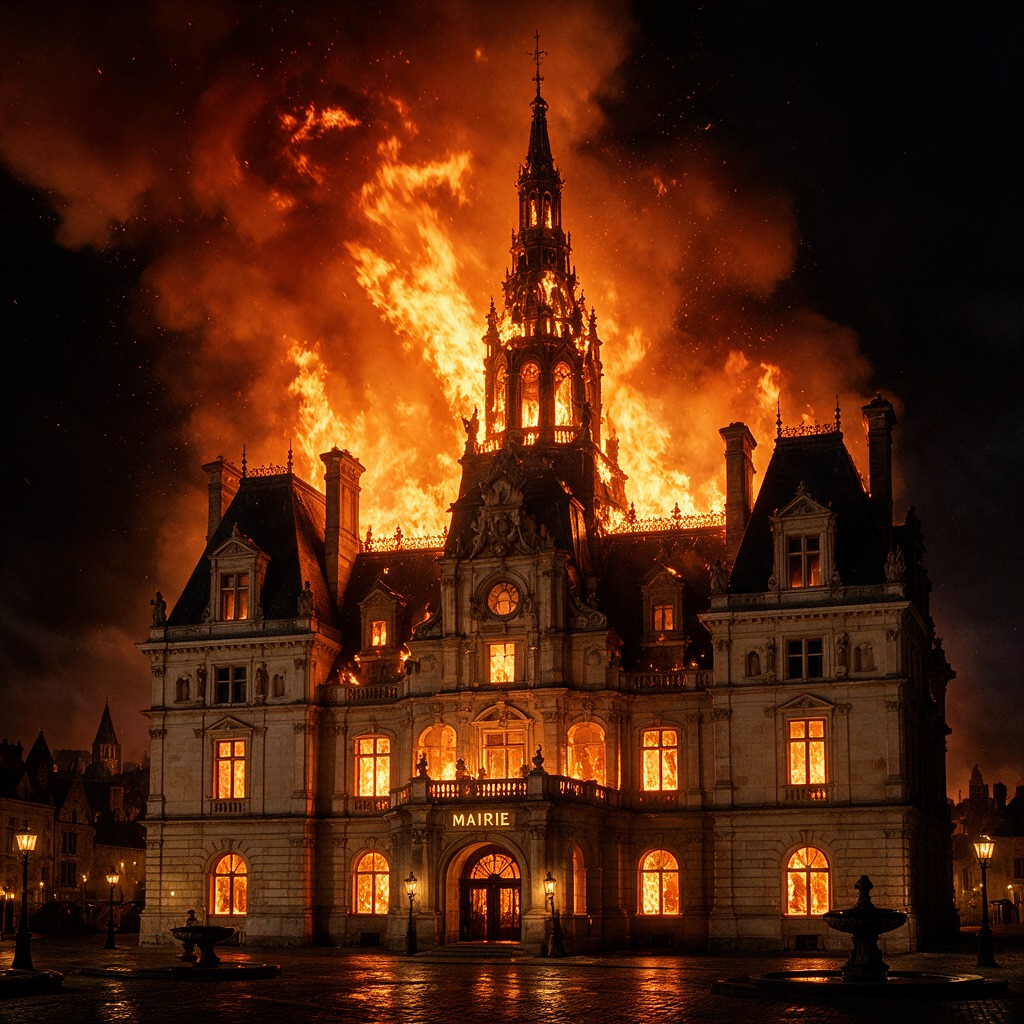
And because there seems no way out; that is, no consensus on a solution, France is seen by more and more people to be broken. And so, we see disparate groups whose aims are at odds, Islamists and Marxists, university students and workers, coming together, not just in protest, but for a significant number, to destroy; to burn it all down, one presumes, so as to rebuild along new lines. I don’t quite know how aspirations for a socialist state, Sharia law, a post-national country, a feminist culture, and so on can possibly be reconciled into any coherent social, economic and political plan for the future. It would seem the more immediate aim is just to destroy, to burn the bridges to prevent any going back. To erase the heritage, so no one can remember the way back.
What is it behind them, in the past that so frightens the modernist forces of secular France, the liberals and socialists who will come together to stop its coming? What is it that the Islamists wish to vanquish? What have so many people of France, and of the West generally, been brain-washed into believing retrograde, misogynist, racist, intolerant, unscientific, etc., all the things that either eschew or contradict the modern virtues as expressed in the many “isms” of modern ideology? What is it that is ridiculed in our culture so often? What was it that France, or more accurately its elites, mocked in the Olympic opening ceremonies so recently?
Well, it’s Christ and his Church.
We do need to remember that all of these groups are essentially heretics, that is, from a Christian perspective. St. Thomas Aquinas judged Islam a heresy, a very confused one at that. Serious historians (Holland, Burleigh, to name two) see how modern ideology is traceable to Christianity: we could say that liberalism is secularized Protestantism and socialism a form of Catholicism emptied of God, with theology swapped out for economic theory, but still very much a “church” on the march, not into the kingdom of God, but to an earthly paradise that’s always just over the next hill.
Why have so many of us, even confessing Christians, gone along for generations now with this program of dismantling Christian society? It has a lot to do with the traumas of the 20th century and the Second World War in particular. We could half seriously say that Satan lost his infernal throne to Adolph Hitler. And the fault of it all was assigned to all that came before. To object to this analysis is to risk being labelled a fascist. The discredited past, of which Christianity is a substantial part, is the rationale of for the vandalism we’ve seen in recent years here in Canada, and the fires that are beginning to consume France’s heritage – the Louvre is closed today with worries that rioters could consign the Mona Lisa to the flames.
The National Socialist regime of Germany, “the Nazis” did bring about an historically unequalled horror: industrialized slaughter for those deemed their enemies. After their defeat, the vow taken up was to never have this happen again. So, there was a serious process of vetting institutions and associations of the ideas of previous centuries that could be seen as contributing to the murderous ideology of the Nazis. We’re talking about eugenics, militarism and the rejection of liberal democracy as obvious examples.
Unfortunately, the racism of the Nazis was conflated with nationalism, tainting the natural expressions of pride in country and community that human beings are given to; but even further than that, came a denigration of the civilization that had given birth to the nations of Europe. While not perfect, what that community of nations accomplished is singularly remarkable.
Equally held in contempt was the military. Watch any film or television show set outside of the story of the heroic struggle against the Nazis, and generals and admirals are more often than not portrayed as paranoid, right-wing, and intent on war for the sake of glory.
Lastly, criticism of our democratic systems was dismissed as being everything from crackpot to traitorous even as we could see how ineffectual our democratic governance has increasingly been, how it has degenerated into competition among parties to buy our votes with our money, or more accurately, with debts imposed on us, our children, and their children. While some clearly want an overthrow of democracy, most just want it to work better than it has in the past fifty years or so.
What defeated Nazism was a coalition of nations grounded in Christian faith and a modest pride in what had been built over generations in terms of national communities. And what gave stability to nations were the Christian faith communities that provided mutual support and aid to those in need through neighborliness, but also through the Church’s institutions. These were worth defending. Is there now anything left to defend?
When we are faced with questions from the political establishment, of the left, right and centre, about our priorities as Catholic Christians, how to deal with poverty, how to address historic wrongs, how to build a just society, a vibrant economy, etc. we must recognize that often there is no genuine desire for dialogue: they are traps, veiled accusations that we don’t care about the poor, that we just want to impose our faith on others. If we don’t endorse their proposals, we are the worst kind of people. Yet the proposals are never anything new, always their failed ideas repackaged.
As Christians our aim is to transform the societies in which we are a part into those that prioritize the good of all, with proper discernment of God’s will to uphold truth and justice. To chart a way forward, and not just in terms of the wants and desires of present voters, but with an eye to the future and the kind of society that affords its young opportunity, its aged comfort, its newcomers welcome, and all its people peace and order, freedom and justice so that they may pursue the true human vocation of knowing God, loving and serving Him in this life so to be forever with Him in the next.
The artist and poet William Blake penned his great poem, “Jerusalem” (later set to music, and so, becoming England’s unofficial national anthem) in the midst of an industrial revolution that was transforming, and frankly, disfiguring his country. Boldly, he suggested that the project mandated by God needed to be taken up again, himself vowing that,
“I will not cease from Mental Fight, nor shall my sword sleep in my hand: Till we have built Jerusalem in England’s green & pleasant land.”
Indeed, Jerusalem is something to be built everywhere, the shining city on the hill, lit not by the fires of hate and resentment, but illuminated by the glory of God.
Amen.