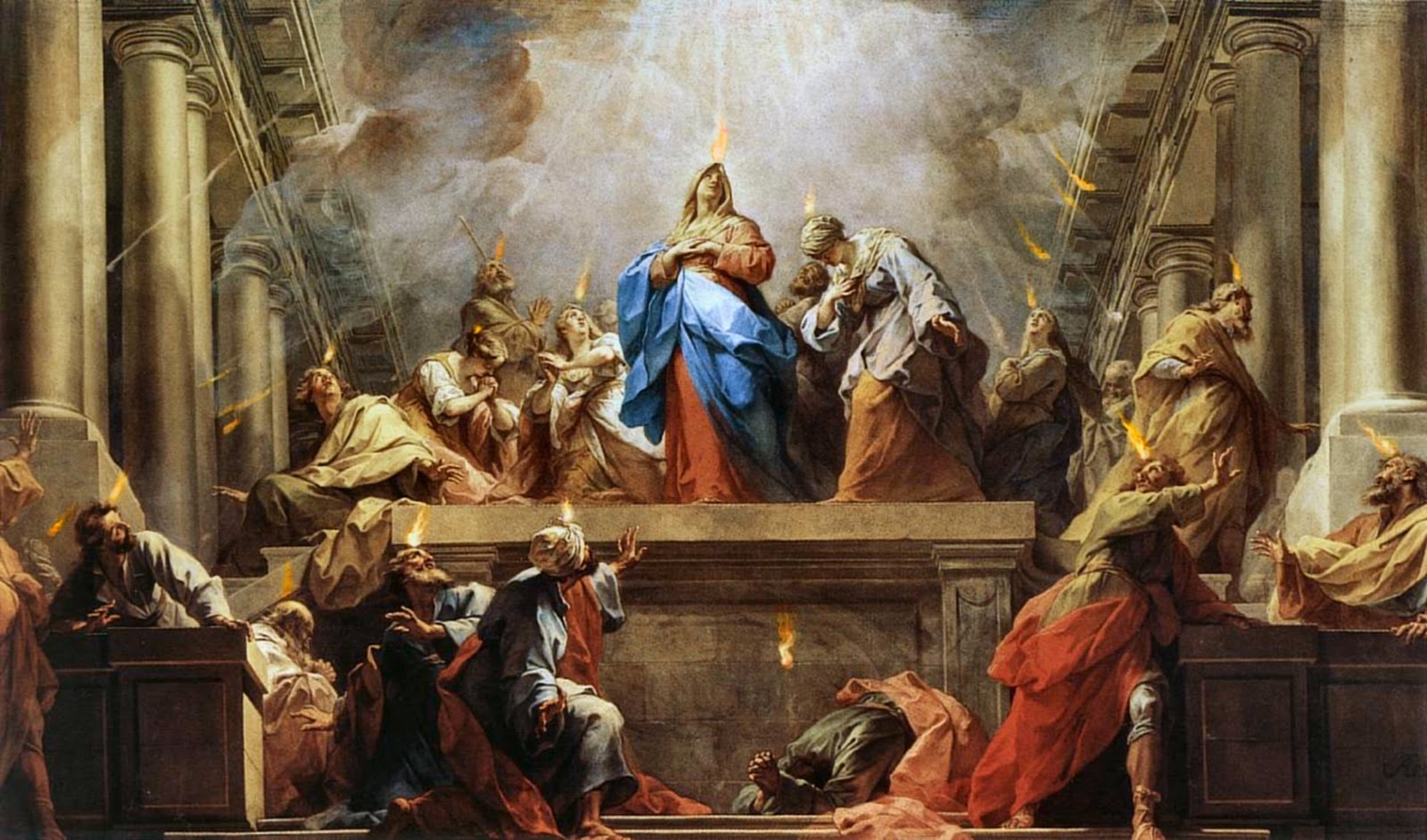
Mass readings for Pentecost:
Acts 2.1-11 Psalm 104.1ab, 24ac, 29b-30, 31&34 1 Corinthians 12.3b-7, 12-13 John 20.19-23
We all know the most important day in the Church calendar: it’s Easter. So important, that it’s an eight-day day – we stretch its celebration to over a week, and a season that ends today. The next most important? Christmas? As I am raising this matter today, some might have rightly guessed the answer, it’s Pentecost.
Today we rejoice at yet another self gift of God beyond the incarnation. At the first Pentecost we received him as the Holy Spirit, the Paraclete, a word we translate into English as advisor, counselor or helper.
God’s first self-offering is in creation. The Father in His creative power sacrifices His splendid singular perfection of being, and wills the existence of being outside Himself, and so gives us life, and a world in which to live it freely. God again offers Himself to redeem us through the Son incarnate. Lastly, God gives of Himself in His Holy Spirit, an abiding, constant presence to assure us of His love and to guide us.
However, while we can look around and see that we are living creatures, and live in a beautiful if fallen world, and so know God as creator; while we can appreciate the Son through the history of his appearance, his Passion and his Resurrection, and can see in the witness of the Apostles, the truth of it all; how do we know of this gift of the Holy Spirit as truly one we’ve received, as a community, and as individuals?
In a visit to prepare for the confirmations this past Thursday, one of the confirmands asked me about this: how do we know?
I said that for most of us the assurance of the Holy Spirit’s presence is difficult to verify because of our fallen, sinful nature; it is a grace to be able to perceive Him, but that most of us likely know of Him more by His absence, the sense of something, or someone missing from our life. When he’s with us, we have a confidence that can often be at odds to our circumstances – an essential hopefulness that persists even in the midst of fear or grief. It’s by the Holy Spirit that we can, with all sincerity, acknowledge God, and call him Father.
St. Hilary tells us that having the Holy Spirit among us, within us, it’s like possessing a faculty of the mind, or a bodily sense – a 6th sense, if you will, but one we were not hitherto conscious of, but in receiving, changes our perception of the world, changes our lives.
If we were to dwell in total darkness, we might never know about sight even as we have eyes to see; if we ingested nutrition through a tube directly into our stomachs, our taste would not be needed, and yet it would be there in our tastebuds. And so too with our hearing if in a silent world, our sense of touch if we lay in a fluid suspension perpetually, never exerting any weight upon any other thing. If all that suggests the womb, well I think that an apt comparison. When we are born, the shock of birth is in part the activation of these senses and in receiving from them overwhelming sensations.
What the Holy Spirit then does is something similar in our sacramental lives. In baptism, the Holy Spirit is integral to our rebirth, an initial activation of our spiritual sense, but if received as an infant, it is not unlike the physical senses of a child – still needing a lot of development. The taste a child has in their food, those who’ve been parents, you’ll know most don’t have the most sophisticated palates, and so, there are years when it seems the only thing they’ll eat are chicken nuggets, carrot sticks and French fries. There are adults who never develop their palates, never venture beyond what they safely know they like, and so turn away from more subtle flavours in favour of what is simply sweet or salty.
We celebrated confirmation with our young people and their families on Thursday, and we must be honest in recognizing that most rarely attend mass. As pastor I can only guess as to the spiritual state they are in. I don’t mean to suggest they’ve grown evil, but rather that this sense of the Spirit, that relationship that Hilary compares to having a 6th sense of God, it can’t be gauged. Has it developed since baptism? Because undeveloped, they will be at a loss when comes the real need of it in the moments of crisis, as individuals, and as part of a community. When God ceases to be an actively felt presence, and becomes mere sentiment; something associated with the innocence of childhood; and then this mistaken for faith, the idea of the Holy Spirit as a reality is easily dismissed – an ironic twist on the words of St. Paul who wrote that when he was a child he thought as a child, and spoke as a child, and so on.
The drift of our society, the loss of confidence in the project of our civilization that I spoke of last week, that comes of not having that sense of God. The aimlessness of individual lives, the discouragement, the horrible sense of resignation to things just getting worse, this comes of no sense of God, no Holy Spirit to lighten the burdens, leaven the soul and inspire people to seek God while he may yet be found in this life.
We possess as the Church the Holy Spirit both as individuals and corporately. This is a great help to us all when our own personal sense of God wanes, because with confidence we know where to go to revive our capacity to let the Spirit work within us, to surrender to its care of us; that is with others who share in the gift. But where that community is absent, or when we no longer participate in it, we are in danger of shutting ourselves off – as if we were closing our eyes, plugging our ears to the sensible world, we do so toward the spiritual reality of life. And as individuals do this, so then it becomes a social phenomenon and our society empties itself of God’s animating spirit, and it starts to die.
The British scholar David Butterfield was recently interviewed. He made the news in a small way by being a professor at Cambridge University who resigned and gave up his tenure, and not because of some scandal he’d brought on himself. Rather, he left over the scandal of what had become of that university. It had lost its spirit.
We shouldn’t forget that the institution of the university is the Church’s creation, and its mission was that of seeking knowledge – first, and foremost of God, seeing the investigation of the universe as a way to know God better.
He’s left and founded a new college, one that is animated by the essential elements that should comprise its foundations; what some describe as the marriage of Athens and Jerusalem, the Greek legacy of intellectual inquiry into the world, and the Christian faith coming together to create a uniquely compassionate and technologically innovative civilization. That is, our civilization is one built upon inspired intellect, curiousity informed by the revelation of God, a belief that underlying the bewildering complexity of things is the logic of God ordering it according to Christ, the creative Word, and sustaining it through the Holy Spirit.
Lose one’s sense of that, and one is lost, overwhelmed, and the universe ceases to be a means of knowing God, and it becomes instead a threatening, interminable black void.
And that is why we have the Church, born at Pentecost of the Holy Spirit, to provide that means, that avenue by which we can receive and renew our relationship with the Holy Spirit. We know we can’t make people have faith, we can’t compel them to receive the Holy Spirit. Yet the Church’s ministry has always been to prepare people to receive, invite them to come and partake, to form themselves intellectually and spiritually so as to receive the needed inspiration to live as productive people engaged in the business of growing holy. The byproduct of that is a civilization such as we have enjoyed, in all its imperfections, in all its faults, but also in all that it has accomplished through the inspiration of God and the gifts that flow from that coming of the Holy Spirit. So, our work of ministry must go on with even greater effort.
That’s how it all works. We start as individuals being remade by the power of the Holy Spirit, and in our striving after holiness we remake the world around us. We might remember this bit of Shakespeare, “O brave new world that has such people in it.”
People of faith, and so, of hope.
Amen.