

Mass readings for the 26th Sunday in Ordinary Time:
Ezekiel 18.25-28 Psalm 25.4-5a, 6+7b, 8-9 Philippians 2.1-11 Matthew 21.28-32
In Jesus’ parable we have two sons: one who says he will do as his father asks, but then doesn’t. The other refuses his father, thinks better of it, then goes and does it.
We likely ask ourselves, which am I? And the answer is probably a bit of both, but as faithful Christians we are apt, or should be, to answer in just that way. We are called to critical self-examination. We aren’t always the faithful and obedient child, but we’re trying. Yet, I think the point of this story really lies in an emphasis upon that second son, and the hope inherent in his example.
If we think about these parables of the vineyard, and we’re in the middle of a trilogy of these, another one to come next week, it’s clear this is about the Messianic mandate to gather the people, to reconstitute Israel. And Israel today, while we do have the Jewish state, in our Catholic and Christian understanding, the new Israel is the Church, and so these verses are to be applied to the mandate of building and rebuilding Christ’s Church in every generation until he comes again.
As with last week, the gospel is calling for us to consider the lapsed, the absent, the apathetic. Last week, I said we should take the parable of the vineyard owner hiring workers as encouraging. The owner hires through the whole of the day, and all receive the same recompense: that is, anyone can be saved up to the last hour of that day and receive the treasure that is heaven. So, take heart with respect to those we love but are numbered among the lapsed, the absent and the apathetic. And it is important to be hopeful because as Christ’s hands and feet in the world, we are the ones going out to hire, and we are his voice; we are to be calling people to him. If we do so feeling already defeated, and so, despairing, we’re not going to be heard. For that would not be the authentic voice of our Lord – that would be just us. And people, as spiritually impoverished as they may be, will nonetheless not see any answer to their predicament in joining what will look like a Sunday morning social club. But if what they hear, and indeed, see, of the Church truly reflects Christ, then the possibility of their eventual turn to God is very real.
So, we must be hopeful, and we have good reason to be; we also have to not become like the first son, hypocritical, living in contradiction to the gospel. As St. Paul tells us today, “Do nothing from selfish ambition or conceit” – that is, your invitation to others, be they friend, family, neighbour or stranger, cannot come from a desire to be seen as a good person, to seem to be a good person, or to swell up a sense of pride in how many people you’ve brought into the Church, be they your grandchildren or someone you met at the bus stop. Always, always, we offer the gospel because we want good things for others, to paraphrase Ezekiel, we want that they live, and not die. We aren’t to care if we are seen to do it and seem to do it; we are just to do it.
Now in this succession of parables of the vineyard we have to remember who Jesus is speaking with and to. Last week, he was talking to his disciples, this week he is addressing the parable to the chief priests and the elders of the people. So, these are the community’s leaders. Jesus, nonetheless, wants everyone to hear this. Be careful of following those in authority, no matter how much they say they have the same goals as Christ. They may be like the second son who says yes, but doesn’t go to the vineyard. Listen carefully to what they say: is there appeal really about satisfying our selfish desires rather than setting us to the Lord’s work? As St. Paul warns, “look not to your own interests, but to the interests of others.” Youth must remember their elders, and the older generation must make provision for the young; third and fourth generation Canadians need to see how the newcomer can be of help, but the newly arrived should not hold themselves entitled to the national inheritance and to do with it whatever they will. In Christ, however, all of this can be reconciled, pray God we can then bring all into Christ.
I’ve described the political and cultural situation Jesus finds himself in before: the territory of Israel has been split up with the children of Herod the Great each getting their bit to manage. The Romans control Jerusalem directly, with the collaboration of the Temple authorities and the Sanhedrin, and the whole of it is now part of the Roman Empire; and throughout that empire now lives a dispersed Jewish population. As the Jews are losing effective control over the land, the Temple, and their future as a people, there is nonetheless fierce political competition for power among their elite. And as I’ve mentioned before, the factions are both religious and political. The Pharisees may engage with Jesus on theological questions, but they are also politicians anxious to reclaim power in Jerusalem from the ruling faction known as the Sadducees who push their own religious and political agenda. Religion and politics are fused together. I think they always are despite the secular world telling us they’re separate things. Beliefs guide the political choices of our leaders, and ideology is their master. Yes, all the priests and scribes, the Pharisees and the Sadducees, and the Herodians are all Jews, but they all have very different ideas as to how to repair the political, economic, cultural and spiritual fabric of their society.
The same situation prevails today. All of Canada’s leaders since confederation have been Christians. The majority of our prime ministers since the Second World War have been Roman Catholic. Yet today we have a wide-open abortion regime and a system of medically-assisted suicide which is fast becoming a source of international scandal. The government uses its resources to promote both domestically and internationally things quite contrary to Catholic Christian teaching, and yet most of the federal cabinet can produce baptism certificates.
And lest you think I’m being partisan, I reiterate that this has been the state of affairs my entire life and even before my birth, with all the major political parties.
Don’t judge civic leaders by whether they go to mass, to Sunday services, or for that matter to synagogue, temple or mosque. What is it that they actually do when they have power? Don’t judge by the rhetoric they employ, that may draw upon the Judeo-Christian heritage, that they reference the Kingdom of God, speak sweetly about social justice, economic prosperity, national pride. What is the effect of their governance on us in real terms? And the effect we must be most aware of us is in how we are less and less the faithful and obedient sons and daughters going to the vineyard as was promised in our baptism, repeated by us in our confirmation vows.
“The tax collectors and the prostitutes are going into the kingdom of God ahead of you,” Jesus tells these important men, dressed in robes signifying their status and authority. How offended they must have been to hear that Jesus assert that most deplorable will go before them, the most pious and religiously correct. I can only reflect on some of the rhetoric we hear today that holds in contempt so many regular folks who don’t share the opinions of those in charge. Question any of the many narratives that makes of us and our ancestors the villains of history, and we are judged deplorable, and to be excluded from civil society. Yet, it is among such as these that Jesus sees the real possibility for the reconstituting of Israel, for the building up of the kingdom. The future is really in the hands of everyday people, and not those who walk the corridors of power, who jet around the world going from conference to conference issuing official statements and posing for the cameras in front of banks of national flags.
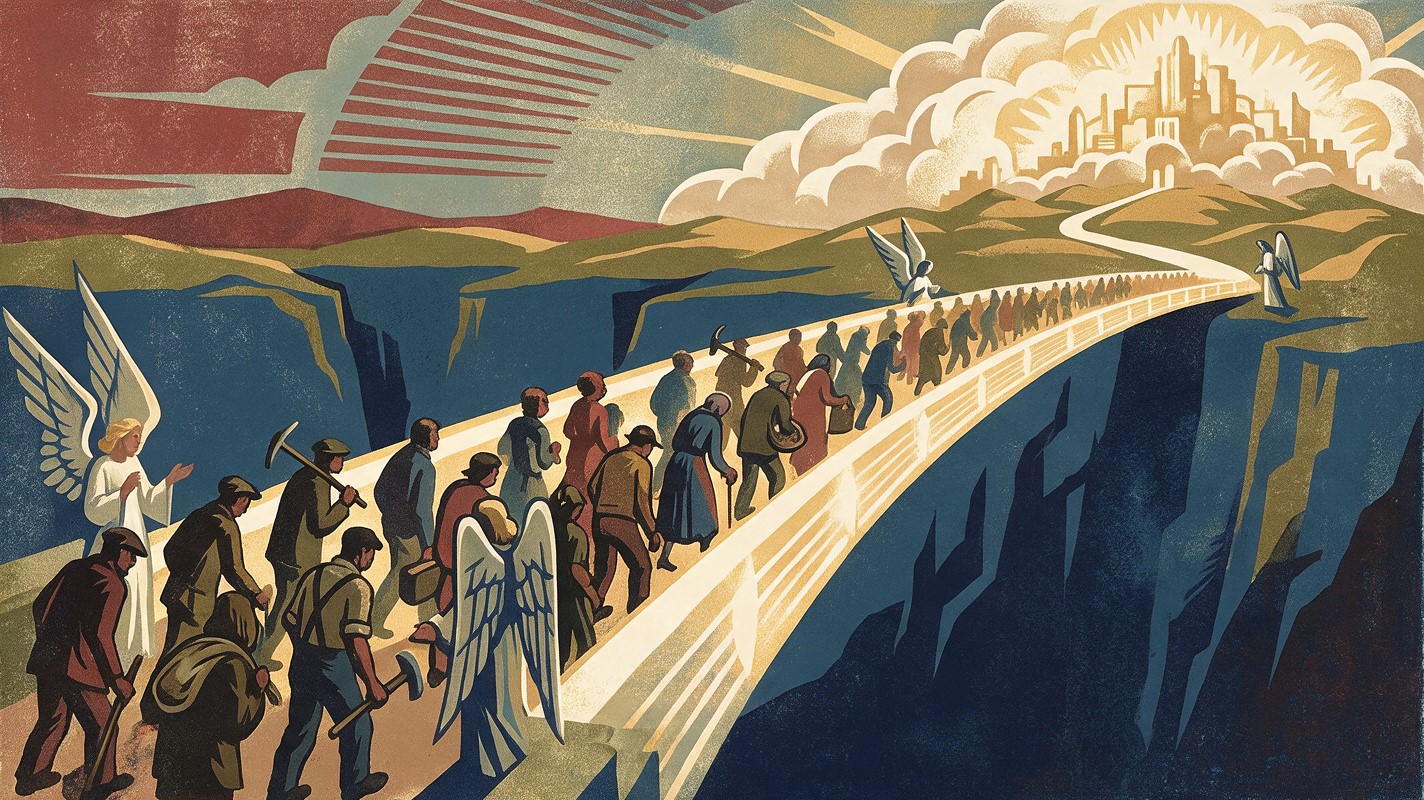
The Christian revolution has always been a matter of the commons, of the people waking up to reality, and then, walking, limping, dragging themselves, toward the kingdom, leaving behind all the powerful and important in the world to catch up with them.
Remember who our Lord and Saviour is, the one who though God, did not take the form of God, but who rather emptied himself and took our form. Humble, obedient, he doesn’t just call us to go work in the vineyard, he goes there himself. And where he goes, wherever that might be, to the vineyard, to the hill of Calvary, to the kingdom of heaven, we follow him there.
Amen.