

Mass readings for the Solemnity of the Most Holy Body & Blood of Christ:
Deuteronomy 8.2-3, 14-16 Psalm 147.12-15, 19-20 1 Corinthians 10.16-17 John 6.51-59
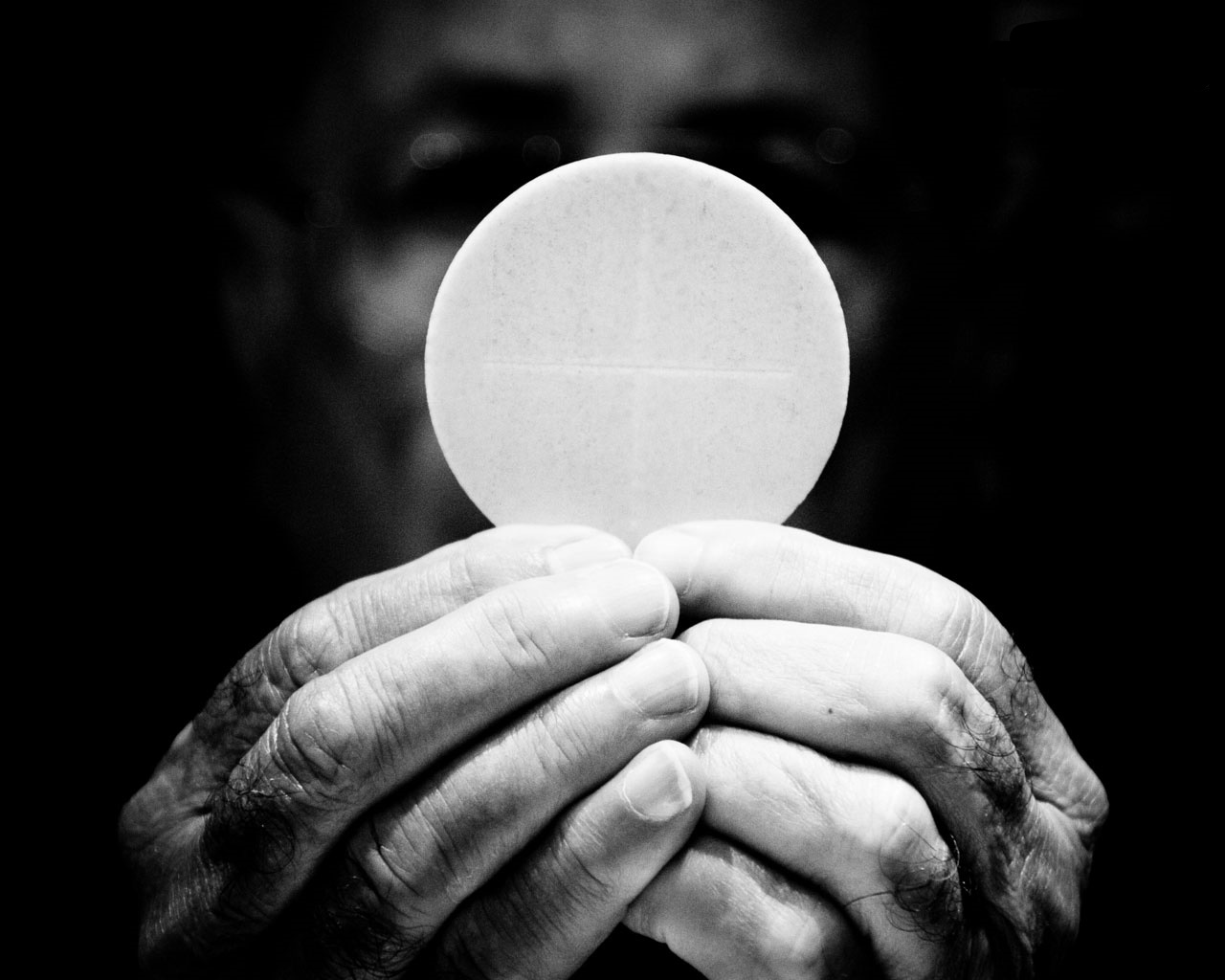
As Catholics, we confess the Blessed Sacrament is more than a symbol, and its celebration, not just a memorial. In the Eucharist we return to the moment of Christ’s once-and-for-all saving sacrifice; in the host we have the body and blood, soul and divinity of the Lord.
We know the substance, and are not caught up in appearance, even as we take in the symbolism in its richness, we know there is more – more than an idea, it’s a reality, more even than that: a supernatural substance beneath a mundane surface. Of course, this perfectly reflects the person of Jesus. In the testimony of the gospels and in the prophecies of the Old Testament, we are told the Messiah would not have an exceptional appearance. Yet, we know that what Jesus accomplishes is singularly extraordinary. Isaiah said, “He has no stately form or majesty that we would look at Him,” yet to meet him was and is life-changing.
One understands the scepticism of the world, and of those in our gospel today who scoffed at Jesus’ claims. How can this man give us his flesh? How can the mass confect the divine substance of God and then hand it out to the faithful? This must strike the outsider, the casual inquirer into Catholic Christianity, as ridiculous.
How sceptical must the average person today be? Awash as we are in media, a communications network of devices that deliver images, sound, words and pictures to us, much of which is trying to sell us something, convince of something, convert us even, recruit us to a cause.
As consumers in the marketplace, we’ve experienced the “bait and switch”, we know the tricks to get us to buy, the soft sell, the hard sell, we’ve watched the commercials that make of a fast-food meal deal an unparalleled taste sensation when it’s just another trip to the drive thru followed by indigestion. And yet, it works, again and again. Even when we don’t have the money for it, we scrape it together or put it on a credit card – Canadian household debt is now at record highs as people try to live the lifestyle as advertised.
As citizens, we encounter this in politics. We watch carefully managed media events, and take in finely crafted words and curated images as if these reflect real things. We regularly see the standard visual ploy of the politician appearing in his dress shirt, collar unbuttoned, sleeves rolled up, and telling us all how hard he’s working for us. The reality is that most don’t lift anything heavier than a pencil day-to-day, and many come from a background of wealth and privilege, or have been so removed from everyday life for so long, they struggle to convince us that they “feel our pain.” So often, there is nothing being done, things getting worse, and the hard work being done is in convincing us to reelect them.
I say these things continue to work, until of course they don’t. And we may be in a time when the words and images that had once been so convincing are failing. And they fail because they don’t correspond to reality as we unavoidably experience it – the comforting illusions are being dispelled. Life is no car commercial, and whatever has been the guiding vision of our society seems more like a hallucination.
What then does the Church offer? From a distance it is a bit of bread, on other occasions a dab of oil, a few splashes of water, hands waved by a priest as a benediction? No, we offer Jesus Christ. And not just a memory of him, not just a record of his teaching, but him, himself. And through him is promised eternal life, inner peace, a reconciliation with God over our sins, and a renewal of our purpose as God’s children now committed to his kingdom. All this, and reality too – for there is suffering even as there is joy, a cross to bear, but also a victory over sin and death.
You know there’s this old bit of marketing wisdom: sell the sizzle not the steak. And some take that as advocating deception, when that’s not the case at all. Really, it’s the reality that to sell us a steak dinner, there are only words and images to entice us. You cannot smell, touch or taste; and in reality, you can’t even see that steak dinner. I knew someone who worked as a “food stylist” and she told me that for those ads, the pictures in illustrated menus, the tv commercials, what they do to the food to make it look appetizing renders it inedible. They spray lacquer on it, they use chemicals to fluff up the mashed potatoes, make the green of the asparagus pop, create the illusion of a steak dripping with flavour with injections and sprays. But I get it, what else are they going to do to simulate the reality they want us to enjoy?
Until we actually taste the actual steak on offer, we don’t know. And for a lot of people, the wise course is not to trust the ad beyond the restaurant address and the prices they post, and then to ask around, have you been? Is the food any good?
The proof of the pudding is in the eating, is the old saying. We must try, test, sample, taste…
Catholics should, before all others, be people who instinctively know this wisdom. Our sacramental life is one is filled with sign and symbol, but we know of truth within the mystery by our partaking of it. Taste and see that the Lord is Good; Happy are they who trust in him.
How good are we as salesmen? Well, to be convincing we should know what we offer and be ready to answer the questions. What’s in it? What does it do? How do I know what you’re telling me is true? That’s the sizzle, as it were, but really, we’re not here to sell anyone a steak dinner, we’re here to invite them to the Lord’s supper.
When we recommend this sacramental life, the summit of it being the our Lord’s Body & Blood, Corpus Christi, what can we say? – It is indispensable: unless we eat it, we have no life in us. It is not merely a discipline, a ritual, a nice way to spend an hour on a Sunday morning, it is the means by which we grow closer to God: as he incorporates us into him, we incorporate the eucharist into ourselves. And how that works? We might speak of human psycho-social dynamics, explain worship as a therapy or an exercise of our neglected spiritual senses; but in the end, we have to admit, it’s a mystery. But that’s the secret ingredient, and what marketing guru doesn’t know how that tantalizes. Yet this isn’t a secret spice or any human concoction that we will eventually tire of as we look for the next taste sensation. No, this sacrament is not sensational, its salvational; it does not linger on the palate a few moments and is gone; rather it is hardy fare, food for the journey that will sustain us into eternity.
Amen.