
Mass readings for the 28th Sunday in Ordinary Time:
Isaiah 25.6-10a Psalm 23.1-6 Philippians 4.12-14, 19-20 Matthew 22.1-14
In recent weeks we’ve heard Jesus describe the Kingdom of Heaven as being a vineyard in need of workers. This week we hear him shift in metaphor to now likening the kingdom to a wedding banquet. In each instance there is an invitation: to work in the vineyard; and now to come to the party! Who doesn’t love a good party?
The kingdom of Heaven, we should recall, is not the same as heaven. Rather, what Jesus is talking about is the beginning of the reconciliation of heaven and earth, the coming together of the divine and mundane realms that is now started. Indeed, Christians talk of there being a wedding of Christ the bridegroom and his bride, the Church—that is expressing the same idea. Our scriptures are full of descriptions of what that kingdom looks like in its fulfilment, at least in figurative terms: the lion lying down with the lamb, there being no more tears or suffering, as in our first reading from Isaiah, a great banquet atop God’s holy mountain, etc. That is eternal peace, and eternal life for all those who succeed in being a part of that process of reconciliation. But it begins with the inauguration of the kingdom on Earth. That was initially Israel – the people identified with Abraham, Isaac and Jacob, who lived in a kingdom founded by David and brought to its fullest territorial extent by Solomon. Our scriptures tell us how it was to be a light to the nations, that by its witness of faith it was to draw all humanity to it, and then with Israel everyone would worship the one true God. But that failed because of the infidelity of Israel, especially of its kings.
But God didn’t give up on his people, and instead he seeks to establish a new covenant, a new deal, by which a holy nation will be established, and a means of salvation made available to everyone. That is, to accomplish what the first Israel was to do. And in a sense, it is actually facilitating the first Israel’s fulfilment of its mission. For salvation will come through the Jews – we have Jesus, of the House of King David. But just as Jesus will be killed and rise from the dead, so too will the project of Israel come to an end with the establishment of a new Israel rising from the ashes of Jerusalem. And again, that is the Church. We are the kingdom of Heaven, but only in its beginning.
That’s why the vineyard is a good metaphor because it tells us there’s work to be done. But then how are we to understand comparing it to a wedding banquet, and make sense of the details of this parable we’ve heard?
It’s important to understand that the wedding hasn’t happened yet. We are still in the process of inviting people, and they’ve been arriving at the banquet hall now for 2000 years. Indeed, in every generation we’re putting up more tables, setting out more chairs, finding places for yet more and more folks; and they keep coming.
We’re also told that we’re letting in both the good and the bad. Lots of people get baptized. That doesn’t mean they are all saved, that they will actually get to be at and see the wedding, and then enjoy the banquet that follows.
The ancient Christian writer Origen says that while a lot of bad people might get in, it doesn’t mean they stay bad. As he says, many will put on the wedding garments that are provided.
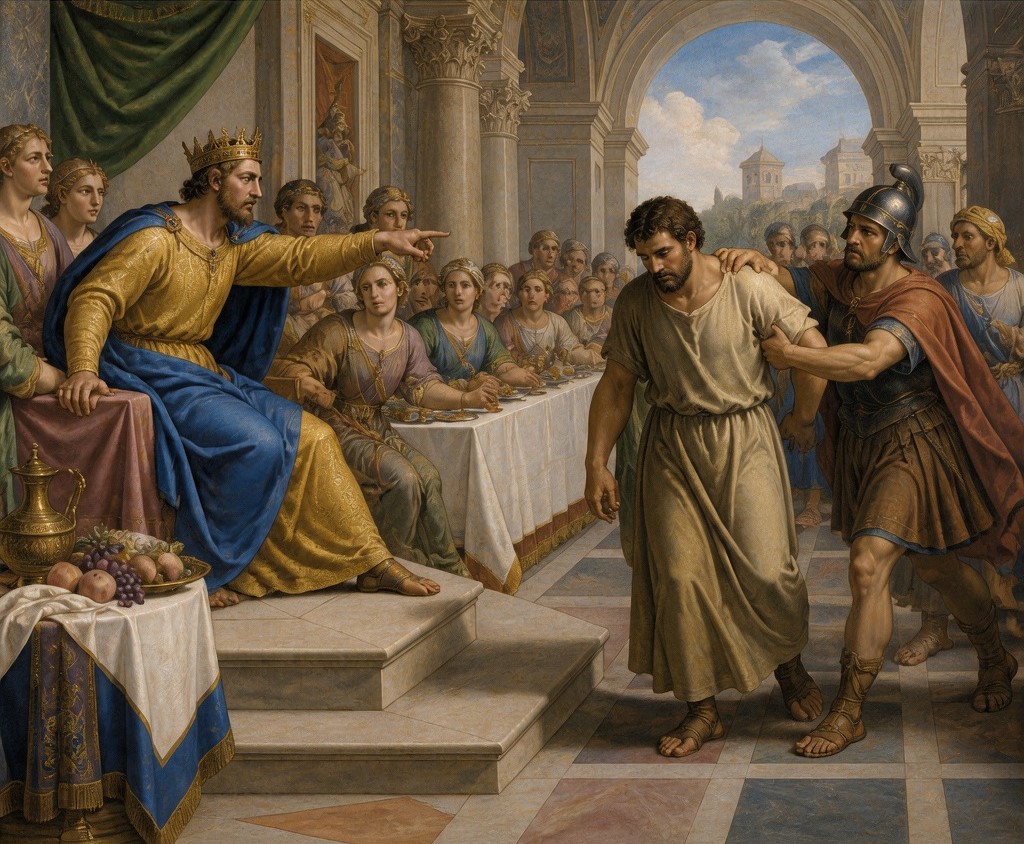
And that’s important to remember about Jesus’ parable: he’s evoking the idea of a royal wedding in the court of a middle eastern potentate – and that meant that anyone who didn’t have a wedding garment would have one provided. These were lavish affairs, and an invitation offered to the humble was not to result in their embarrassment – the host ensured that didn’t happen by giving the needed clothes for the occasion.
Now, think about how when we are baptized, we speak of a spiritual garment that God gives us. Unseen by our eyes, but symbolized in the baptismal gowns that babies often wear, we are to bring that “unstained” into his presence at the end of our mortal existence. That’s the robe we’re to wear on the day of the big wedding; and we who are baptized have it on right now, as we gather here, being in one sense at the banquet waiting for everything to begin.
And all that should serve as an important caution not to be ignored. We absolutely need to be properly dressed. And what is so concerning to me as a pastor, to the priests, the bishops, the lay ministry, to the extent they remember the necessity of everyone in our care to be dressed and ready for the big day, is that so many live their lives counting on the fact they got the invitation as the guarantee they’ll be at the wedding.
St. Jerome tells us, “The marriage garment is the commandments of the Lord, and the works which are done under the Law and the Gospel, and form the clothing of the new man. Whoso among the Christian body shall be found in the day of judgment not to have these, is straightway condemned.” This is the man in the parable who is thrown out of the banquet.
So, does this mean we’re in if we contribute to the food drives, do the fun-runs for cancer, drop change in the Salvation Army kettle at Christmas, are generally a “nice” person, we’re in? Well, those are good signs, not particularly outstanding evidence of sanctity, but we would encourage people in this and tell them to keep going. But as with all such things, we cannot fall into the trap of thinking our works save us, anymore than turning up at mass from time to time will have us staying for the wedding. Indeed, this is finally a matter of the heart and mind being either in Christ, or apart from him. We are clothed in our deeds, but our hearts determine just what those clothes really look like.
St. Augustine added to the commentary of Jerome with this key observation about the man who is thrown out of the banquet as the king made his entrance to begin the festivities: the man without the correct garment wore clothes of his choosing; by being distinct in his dress, drawing attention to himself (I mean, the king spotted him in the crowd of guests) he clearly went to the banquet seeking his own honour and not the bridegroom’s.
I encounter this to a disturbing degree with those who have been taught and in turn teach this is all just about us: that church is about community, about fellowship, about family and friends. Of course, these are goods we have as a result of our coming together in worship, but what this is about is so much more. Now, most teach and pass on this sensibility quite unconsciously, but nevertheless this is what they do. Parents teach their children this especially when going to mass is strictly occasional, that is, it’s a special occasion. Because in that, they tell their children, “This is about us” or “this is about family” or “this is about the party” – that is, we’re here for the food and the dancing, to see our friends, not really here to celebrate the wedding, not really here for the bride and the groom, but here for ourselves and what we get from it. And when the Church prepares and celebrates the mass in this vein, we just reinforce these bad lessons.
When I preside at weddings, I sometime mention this to the congregation, many of whom don’t worship anymore, just come to the church as part of the social occasion. The point of their attendance, I tell them, is to pray for the couple, but also to acknowledge God, and what God in our minds represents as the greatest good. That we should be celebrating the consummation of that love in the covenant the bride and groom are making with God to bring the kingdom of heaven a little more into view for us all through their mutual love and service. To celebrate that they will manifest a love between them that then turns itself outward, and so, becomes a light for others. It’s not just about being happy that Steve and Tina finally got hitched, but that they’ve agreed to become something far more than just another couple making their way through the world in this life – they are children of God going to work in the vineyard, going out into the streets to invite more people to come to the wedding banquet, and to hurry, because Lord knows, literally God alone knows, when the actual wedding will begin.
We’re here for the wedding, and we are excited for it to begin. And, by the way, it’s really our wedding as the Church to our Lord. How strange to be both guest and participant, yet how marvelous.
In the meantime, the host of the feast makes provision for us who are waiting – the Eucharist feeds us who wait, kind of like the food they put out as the guests arrive at wedding reception – it’s not the dinner, but a foretaste of what is to come – a banquet beyond our imagining, but enjoyed not for its own sake, but for what it celebrates: God and his people made one eternally.
Amen.