

Mass readings for the 32nd Sunday in Ordinary Time:
Wisdom 6.12-16 Psalm 63.1-7 1 Thessalonians 4.13-18 Matthew 25.1-13
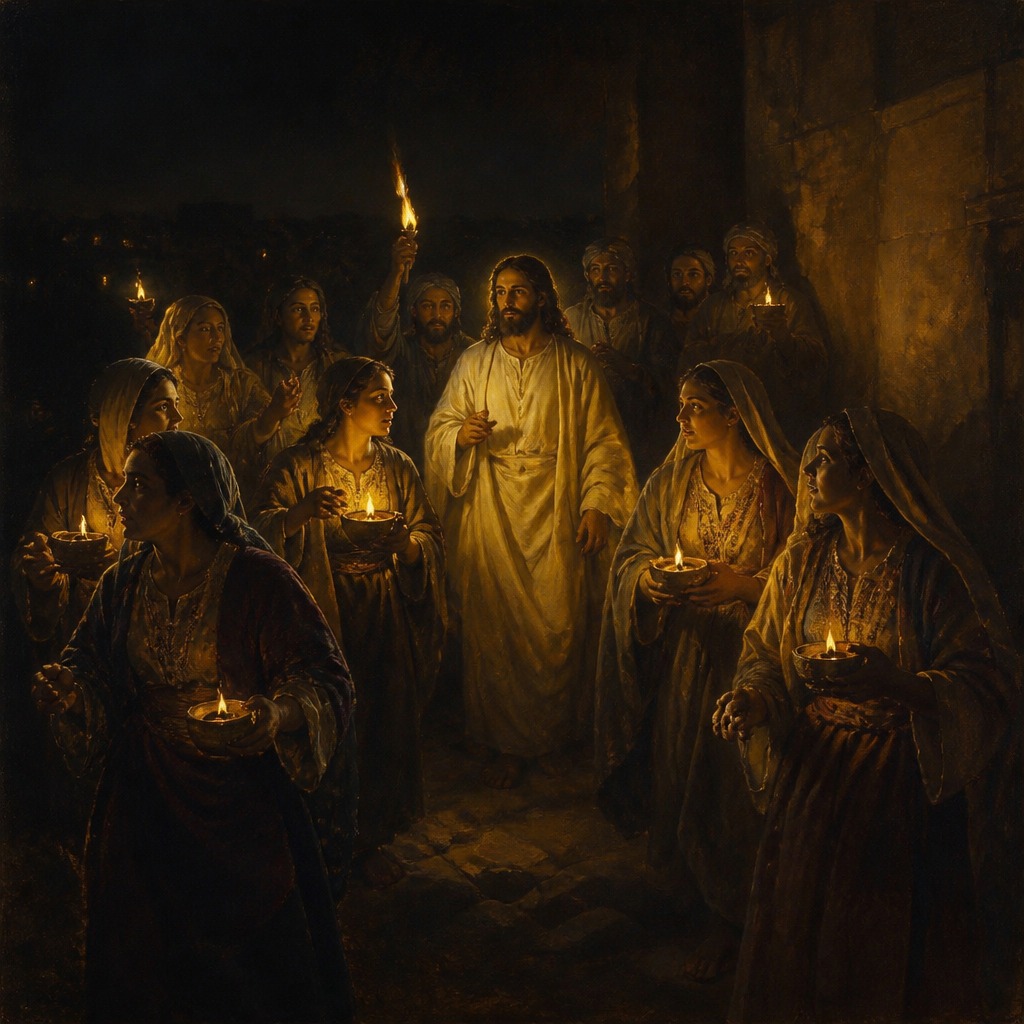
In today’s gospel we hear the parable of the foolish bridesmaids who are shut out of the wedding. They assumed they were getting in; or to be more accurate they presumed as much.
Assumption differs from presumption. Assumptions proceed from belief without proof, judgement without evidence. Everyone knows that assumptions are risky and to be avoided, yet in our weakness, so many continue to make them, and frankly, the world encourages us to do so. A lot of people assume their going to heaven based on nothing more than the feeling they should and so, will.
As the great writer Theodore Dalrymple observed, the modern person’s moral reasoning is worryingly cartesian. You know Descartes: I think, therefore I am. Dalrymple says that for too many people, the similar reasoning is, “I’m angry, so I’m right” or “I’m sad, so I’m a victim” that is, emotions form beliefs, and beliefs, assumptions. Since human beings don’t enjoy honest self-examination all that much, but prefer to protect the ego from anything that could lead to the disillusioning realization that we are not rational, scientific people, and instead emotional, we avoid it. We go in search of ideas, ideologies, religions, including versions of Christianity corrupted by the world, that align with our anger, or our sense of victimhood, or entitlement, and so be confirmed in our convictions that we are good, and we deserve heaven. Yet in such instances, we are not acting on the truth, but upon comforting falsehoods. We then presume to be heading to the wedding, that we’ll be there at the banquet, the proof of that being provided by the personal creed we cobble together. For the foolish bridesmaids, they were not convinced they’d be at the wedding by a feeling, but by what they observed as proof: they had the dress, and an important and seemingly indispensable part in the wedding itself. The sin of presumption is usually understood as us presuming on God’s mercy in light our sins. Today, it’s more the presumption of our right to paradise.
Those systems of belief that provide us with uncritical affirmation, and give us that proof are everywhere. Many “isms” tell us false stories of injustice perpetrated by others by which we are victims, but how we are then prospective champions in the cause of a revolution that will overturn the tyranny–as I’ve mentioned before, they are all horrible parodies of the true Christian faith. Instead of it being a matter of our sin and Christ’s salvation, it’s the sin of others, and our retribution that is the substance of those creeds. And these run the gamut from right to left on the political spectrum. The radical libertarian finds justification for his selfishness as much as the collectivist does for her envy. They’re all made to feel good about themselves in what they believe to be the truth of things.
The parable of the bridesmaids is a metaphor applied to people who are ostensibly of faith. The bridesmaids think they are going to the wedding for understandable reasons. The bridesmaids expect to be front and center, as it were; seen and admired. Yet in our day, this metaphor could apply to secular folks too. They might not think there is a heaven, but they have their own notions of justification, they also want to believe that at their end they’ve lived their lives rightly, justly, and so deserve at least to take comfort in that, but maybe also to enjoy heaven if it turns out there is a God. They also presume much, but not without reason.
The mistake that underlies our presumptions, be they rooted in an incomplete catechism, or the popular culture, is in believing that the proof of worthiness we see is necessarily what God values. We have the invitation to the wedding feast by virtue of our baptism, but that doesn’t guarantee we’ll be there. We may have confidence of our attending the nuptials as honoured guests because of the success we have in this life, and believing these things correspond to each other – but they don’t. We may have a lamp, that is some measure of wisdom by virtue of years and perhaps some familiarity with scripture. But for all that, we’ve no oil, and the lamp is useless. Without it we can’t take up the role we believe we have. And wandering through the dark, we lose our way because we have not gained what we really needed to fuel that lamp and so see our way through the night and into the heavenly banquet.
That the wise bridesmaids came prepared tells us of a need for preparation, for a common-sensical assessment of what is needed for eternal life and what would be welcome in heaven. This is why the Church has its concern that we all be people of regular prayer, of contemplation of God’s word, of critical self-examination proceeding from prayer and that holy word; that we then be nourished and spiritually sustained by word and sacrament. Doing that we cannot fail to understand what will fuel the lamp of wisdom. That oil, oil of gladness, is the humility and thanksgiving that comes of recognizing God’s grace at work in us, that our surrender to him in love is what makes a light for us in this dark world.
As I mentioned last week, the Church has released a document entitled, Venite Ad Me – “come to me” in English, and it addresses the problem of handing down the faith to the next generations. At heart it’s a cultural problem in which the thinking of most Catholics stems from the popular culture and not from their Catholic formation, if indeed, they really had one.
So, think about the tremendous emphasis we have in our popular culture on individuals and their rights, but by “rights” we really now are speaking of entitlements. So, less the right to free speech, and more the right to housing, an income, and to never be offended. And those examples illustrate the idea of society having an obligation to the individual person to deal with all of the life’s problems. The net effect of that care by the state being to infantilize us all.
The reciprocal obligation of the person to his community (and ultimately, to God) becomes rather vague in our current culture. John Kennedy famously said, “ask not what your country can do for you, but what you can do for your country.” Would the entitled and morally confused of today understand what he, a morally flawed man, yet one who knew his catechism, so firmly grasped as truth?
We now live in a world in which personal fulfilment is the primary consideration, but that fulfilment is not understood in Christian terms, as when our Lord tells us that we cannot gain our life but by giving it away; and warning us that the inward turn to self-concern leads to misery and losing life even as we continue to exist.
This all has the effect of keeping more and more of us as dependent children. And that raises huge problems as we try to prepare people for adult lives in which responsibility is key, but also competence, conscientiousness and consideration of others necessary to the proper functioning of civilization.
For even if we all were to say that this is how we want our society to be, where all our wants and needs are rights to be fulfilled by others, especially government, how long before we run out of responsible, competent people to keep things going, who can ensure that the bridges we build won’t fall down, that the medicines we take are safe and effective, that the food we eat will be nutritious and plentiful?
It’s hard to blame those brought up in this culture. I’m not talking about all those under the age of 30. I’ve had encounters with people my age and older who are emotionally stunted, entitled, and convinced of their goodness and deserving of heaven. Yet, in the end they and we are to be held responsible. As too are the many unhappy people we see today, who riot in French cities, who start YouTube channels to make their complaints. Like the spoiled child grown to adulthood, not understanding why the world is difficult, and beginning to comprehend how ill-prepared they are, they know something is needed; and they can’t help but suspect that the lack is in them. They have a responsibility to fill that lack, and to fill it with what actually works, will fuel the lamp, make a light in the dark. We pray that by God’s grace they’ll be prompted to do just that.
We all need the oil of holy wisdom, what teaches us who God is, and so, rightly orients us in this world, gives us understanding enough to make of our existence a true life lived in preparation for eternity, so that at the trumpet’s sounding, we will rise in resurrection.
Amen.Unsa