Mass readings for the 27th Sunday in Ordinary Time:
Isaiah 5.1-7 Psalm 80.8+, 11-15, 18-19 Philippians 4.6-9 Matthew 21.33-43
As I mentioned last week, we have a trilogy of vineyard parables that is now ending with this final, and rather ominous story our Lord tells us about the consequences of being bad tenants. Not only are you kicked out of the vineyard… you die.
Remember how two weekends back we had the Lord as vineyard owner going to the market square to hire workers? He goes all through the day, hiring right up to the last working hour. And everyone gets paid the same whether they worked the whole day or just the last 60 minutes. How encouraging for us who worry about those indifferent to their faith, they have the chance to join us.
Then last week we had the story of two sons, each asked to go to the vineyard to work. One says no, but changes his mind and goes; the other says he’ll go, and then doesn’t. That one still had a somewhat encouraging message, but we have to wonder about the son who didn’t show up. What became of him?
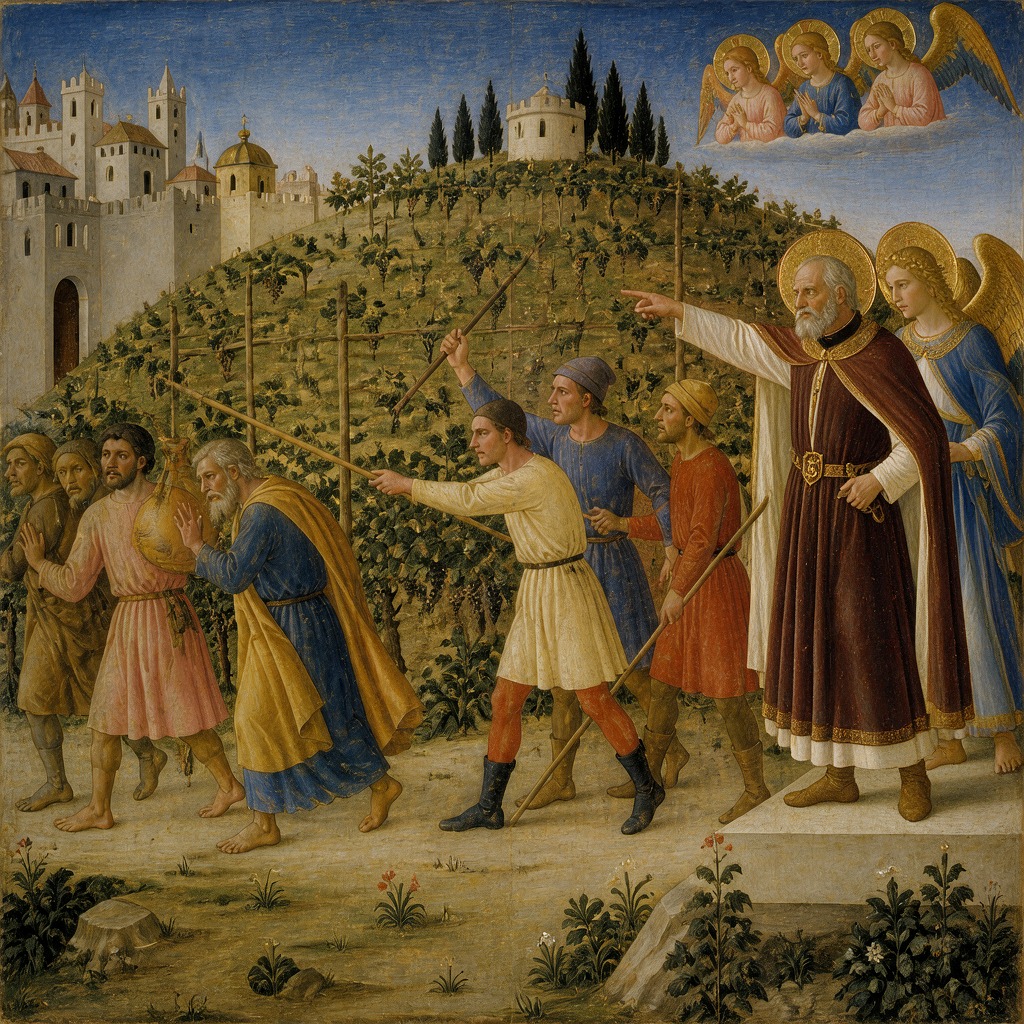
This week we have the story of a vineyard fully outfitted for wine-making that the owner then turns over to tenants. He is looking forward to a return on the investment; but when he sends servants to collect what is rightly owed him, the tenants run off the rent collectors, beat some, kill others. More egregious though is that when the owner’s son is sent, they kill him too and presume to take over the vineyard as the new heir.
We know Jesus is aiming this parable at the Temple authorities, the elders, the leadership of 1st century Judea, and in a sense, of the whole of Israel as a faith community spread throughout the world. These leaders, these men of the Temple, are the wicked tenants.
The applicability of this parable though is not limited to past people and events. As with the other parables of the vineyard, as faithful Christians, we must ask after who are we in the story now? Are we repeating mistakes of the past? God forbid, are we the wicked tenants today?
Let’s first settle what the vineyard is in real terms; and it is not the world. However, the vineyard is in the world, Knowing that Jesus was talking originally about Israel as God’s people wherever they are; it’s not so much a physical place as a belonging to the holy nation.
As I reminded us last week, the Church is the New Israel; the vineyard is then the Church. And again, the Church is not all the buildings around the world where Christians worship; it’s the people who gather in them who are the Church, it’s all who confess Christ as their Lord and Saviour wherever they are.
And that expands the boundaries of the vineyard. Christ being throughout the world, the vines of the vineyard are everywhere too. The most obvious example of the vineyard on such a scale would be Christendom, the Christianized lands of Europe. Later we can say of the Americas where the gospel took root and spread to its four corners north and south, pole to pole, the vineyard is there also. And today, despite vicious, violent persecution in Nigeria, the Sudan, the Congo, etc., Christianity spreads, and so the vineyard is there too.
But who holds the leases? That is, there are the tenants, and then the workers who depend on them for a living. Who are the good tenants? They are the ones directing those in their employ to tend the vines, and eventually pick the fruit, press out the juice, and make the wine. Who are the wicked? Those who claim the fruit as their own, live off the sales of the wine, and get a little high on the stolen supply. They give nothing to the true owner.
Just as Jesus calls out both Temple officials, that is members of the formal religious establishment, and the elders as what we might call the “secular” leadership, we can look at the quality of leadership from our spiritual and political leadership in what were Christian societies now secularized. Most of the governing elite may be baptized Christians, but they are of a culture, and an ideology that is not oriented toward Christ and his kingdom. They have other goals, even as they promise us prosperity, they are working for their own vision of paradise. And they manage the vineyard accordingly, even as they might claim to be good tenants of our Lord.
The examples of their malfeasance can be found on the scale of big and small.
On the small side I note the holding of a discotheque in Canterbury Cathedral on the Feast of the Assumption of the Blessed Virgin Mary this past August. This was the place of St. Thomas Becket’s martyrdom. 3000 people gyrated on the floor to best of 80s music where his blood was spilled. They drank cocktails where the last Catholic Cardinal Archbishop, Reginal Pole, is buried. Those in charge said it was outreach; and besides they made a nice little bit of cash to help with the upkeep of the place.
It was some consolation to read that there were some outside protesting this desecration.
On the grand scale we can look at the former nations of Christendom. They are awash in debts that Pope Francis rightly condemned as immoral for the consequences of this policy will disproportionately hurt the poor, who in our Catholic faith, are of particular concern to God, and so to us.
We can look at our own country of Canada, similarly plagued, but also now profoundly morally compromised. The MAID regime keeps making the news outside the country, but not so much here. The latest outrage being in Belleville, but I won’t go into the disturbing details. Suffice to say that it was bad enough for the police to investigate.
Yet in such things and more, the leadership seems adept at distracting us all with, to quote our Lord, wars and rumours of wars (that is crisis upon crisis) hushing up our consciences with what appears to be a greater existential crisis, getting us to ignore what is really undermining our society, and bringing about its suicide.
Jesus in his ministry consistently refused political power, and made it clear that what saves cannot be found in the realm of politics, economics, international affairs, all those things that fascinate and absorb the attention of the great who then insist we share their fascination. As St. Paul tells us, do not be distracted by the worries fomented in us by the world, but do everything by prayer, supplication and thanksgiving, and the peace of God will guard our hearts and minds. But that means living according to the fundamental truths concerning what is good, virtuous, sacred.
Our salvation lies in our relationship with God, because when that is good and correct, the vineyard will produce, and the wine plentiful and profitable, but most importantly, we know to pay what we owe to our Lord, and see to it that those who hold the lease on power in this and other nations know as well.
It is upon this that we rebuild what is broken in our world, but it is, as Jesus says, a stone that is rejected. Yet for us this is the cornerstone, and around we can remake what was demolished. The vineyard rightly should be leased to those who do this work, fixing the vineyard wall, pulling out the wild grapes, bringing to health the vines, honoring the God who provided it all, and so producing the fruit of the kingdom.
Amen.