
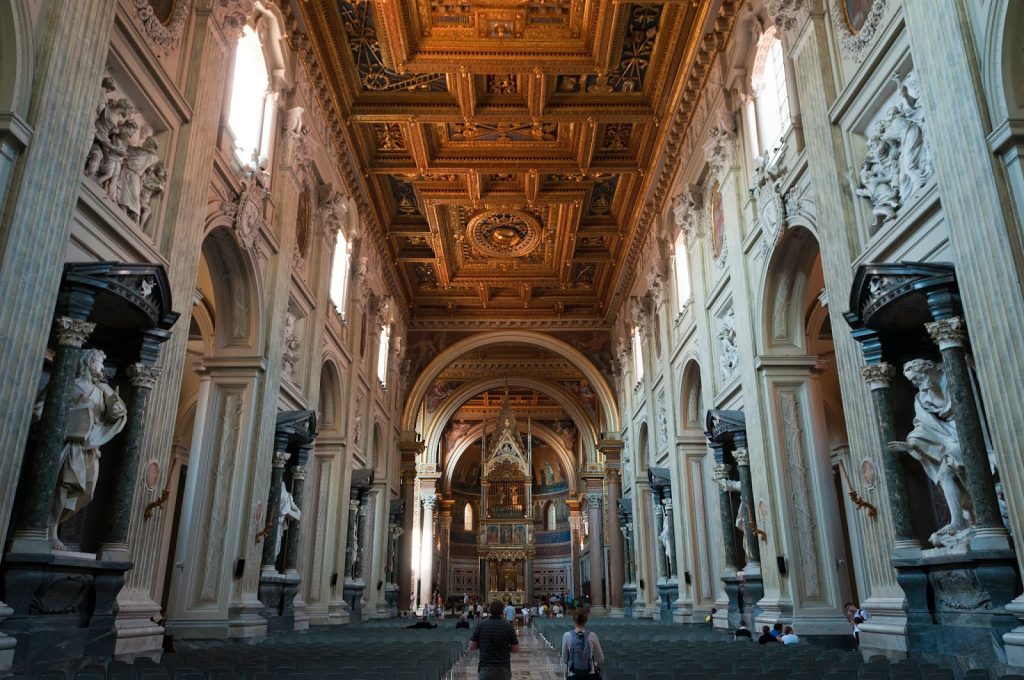
Mass readings for the Feast of the Dedication of the Basilica of St. John Lateran:
Ezekiel 47.1-2, 8-9, 12 Psalm 46.1-2, 4-5, 7-8 1 Corinthians 3.9b-11, 16-17 John 2.13-22
What a strange feast day for most of us! To be celebrating, of all things, a building – a famous building to be sure: the famous St. John Lateran Archbasilica in Rome, the mother church of the Church, the seat of the bishop of Rome, that is the Pope. No, it’s not St. Peter’s! That is the chief basilica of the Church, on the grounds of the Vatican as the centre of the Catholic Church, but with respect to Rome as a city, we look to St. John Lateran to find its bishop – Pope Leo XIV.
I’d say, however, for as much as we’re focussing on this one historic church building, we’re also called to consider this place, St. Augustine’s. And as with St. John Lateran, to think about it is as a place, a monument, a physical testament to faith, to consider what it means that this is here just as much as we think about the significance of St. John Lateran, a church built on land donated to the Church by the Roman emperor, Constantine the Great – the first Christian emperor.
Now, I’m certain that in hearing the scripture readings today, it was made plain that the Church is not a building or collection of buildings around the world. That is a long-standing confusion that Jesus himself confronts. Tear down this Temple, and our Lord said, he would raise it in three days. Of course, he was referring to himself and the “temple” of his body. His body in the world now is us, the faithful joined to him through baptism, and our ongoing devotion to him in the celebration of the sacraments, our personal prayer and study of the scriptures, our service to him through our service to others. We are his body that cannot be destroyed, even as it may be attacked in persecutions, in our individual failings in the face of temptation, we continue to rise with every dawn and go about his work – indeed, we should take care to understand that our devotion to the Church is primarily to her people, brothers and sisters in Christ, building them up in faith, and secondarily our places of gathering. And yet, these buildings are nonetheless important to us. We have “zeal” for them, as our Lord did for the Temple — His Father’s house.
So, why the fuss over this building in Rome? Why do I hear of people’s attachment to this place? Their love for this little parish church in Dundas? So many regard this building as holding a significance that is equal to or even surpasses the regard they have for a house that was their childhood home. Others, not having that kind of personal history, nonetheless respond to its beauty, its acoustics, the environment it creates and they love it all the same. Yet as much as that is a real affection, and an explanation for holding this church to be important; and in similar terms people will look at the great archbasilica in Rome, seeing it as a treasure in terms of art, architecture, the sacred relics contained there, the historical significance – I’m going to press us to think of these churches as important in more objective terms. What objectively is important about that great church in Rome apart from its aesthetics and place in history, and how it is the same for her many sister-churches around the world.
Now when I say “church” I mean a Catholic church; a place of valid sacraments and apostolic teaching. So, I would include orthodox churches. The objective significance of a church I would first point out that its purpose and function is distinct from that of other religious buildings (temples, mosques, synagogues, assembly halls, sanctuaries, etc.)
When St. John Lateran was built as the first major public church building in the city of Rome, notwithstanding that the Church had constructed some smaller buildings already throughout the empire, people had never seen anything quite like it.
They were accustomed to temples; and temples are properly speaking the home of a god, and they are constructed to house a divine image which is taken to be the god somehow manifest, usually an enormous statue of a deity made of something like marble, often clad in gold, and adorned with precious gems. People didn’t gather in a temple, but rather as individuals, perhaps as couples, small family groups, they went in to see the statue, make an offering, and leave. The experience was quite dramatic in the sense that the interior of these temples tended to be quite dark even in the day, and lit only by oil lamps; there’d be the smoke of incense, and perhaps chanting going on. And I know you might say, well I’ve been to church liturgies with incense and chanting, but in this instance, it’s really just the person alone, or with a spouse or friend, coming before this giant statue, and maybe speaking briefly with an attending priest or priestess, then making an offering – money, an animal sacrifice, wine, wheat, etc. in exchange for the god hearing a petition — it’s a transaction across a great spiritual void: the god was in his or her “heaven” and we still earthbound and removed from the divine realm entirely. Such a visit would be typical; and you’d do that maybe once or twice a year. And again, we can make a wry comment about Christmas and Easter Christians, but I’d still say that was a very different experience from what we have here and now.
This place is where the body of Christ is present and made manifest. Yes, in the tabernacle, we have the sacrament: but that’s no enormous statue. It’s relatively small receptacle. There is statuary, a great crucifix; but we don’t understand that to be the god we’ve come to see. That is just an image that recalls to us an important truth about Christ, just as the stained-glass windows also function to remind us of the story we’re a part of, the sacramental life we participate in – these things remind and teach. We know we haven’t come here to worship them.
This place is the home of the body of Christ, and that is us. When we come together in his name, we manifest and make present in the world the Lord – the body of Christ in the tabernacle, the body of Christ in the nave, the body of Christ head to toe, here through mystery. And so, this building has to contain and shelter and protect that body, just as that tabernacle does the same for the Blessed Sacrament within.
Churches then, are purpose-built to hold people, the faithful. They need to hold not just a few supplicants at a time. Indeed, when built, the Lateran Basilica was already too small for the great feast days. It could only hold three to four thousand!
So, the church is a place that invites people to participate in the divine. Not merely be witnesses, an audience to a ritual, at most a party to a transaction across an unbridgeable spiritual divide, but to be an intimate part of the action, to enter into communion with God, to see however fleetingly, the coming together of heaven and earth.
Now, you might then say, well what about mosques? What about synagogues? People gather there and pray, isn’t that the same?
No, there is no sense in the theology of Muslim or Jewish worship that the faithful of those religions are participating in or partaking of the divine in any real sense. What they have is something like the first part of mass: scriptures are read, and then there is preaching. There is prayer, thanksgiving and supplication to God – but there is no manifestation, no coming into the presence of the Almighty in the kind of definite terms we speak of as Catholics. Now, the sceptic may say that this doesn’t really happen in a Catholic church anymore than it does in a synagogue or mosque. But crucially, we say it does—that is our bold assertion that God is among us; and we have the testimony of two thousand years to back up the contention that something is going on here that doesn’t happen in any of those other places.
The donation of the Lateran Palace to Pope Sylvester I in 313 A.D. marked a turning point in the life of the Church. This was an instance of worldly power recognizing the that claim, and allowing it, as it were, “space” within the world that, from a Christian perspective, had hitherto been very hostile. A church building asserts the presence of Christ in the world, and that the Church is therefore in her rightful place too. Now, a consequence of this is that there is no running away from persecution, suffering, scandal; but then her victories are also seen by all. St. John Lateran is a visible expression of the Church’s passage through history. Battered and damaged, burned to the ground and rebuilt — she stands. The basilica actually sits near the Roman city walls and so, has been sacked many times by invading armies. We keep company with all the suffering, and in solidarity uphold the dignity of the downtrodden, the defeated, even as we are so quickly forgotten in the good times, and even called out, falsely accused, libelled and insulted, but all quite visibly because of the place we now have in the world. And our St. Augustine’s fulfils that role here too, however more modestly.
At Christmas we name the saviour as “Emmanuel” – God with us, but we remember how hidden he was in the story, mere infant under threat. Today, there is no more hiding, but rather by the bell tower that rises above this town, by the magnificence of St. John Lateran in Rome it is known, God is here; and that is a challenge to the powers of this world. Indeed, it is a threat to them; and throughout history right up to today, they’ve gone about knocking down churches, burning them, vandalizing, desecrating and defiling; and we keep building, and repairing, cleaning and consecrating them, making a place for the lost to find God, to be healed, forgiven, nourished and sanctified, to find a home in God’s house, a place among his people, and peace in the love of Christ.
Amen.