Mass readings for the Solemnity of Our Lord Jesus Christ, King of the Universe:
2 Samuel 5.1-3 Psalm 122.1-5 Colossians 1.12-20 Luke 23.35-43
This past year the phrase, “Christ is king” became a matter of controversy with some identifying it with something described as “Christian Nationalism” – a sly association with the darkest chapter of the 20th century when nationalism was a key aspect of the fascist regimes of Germany, Italy and Spain. It was also suggested that this was subtle antisemitism, as Christ’s kingship, by inference, renders the project of Israel as a nation-state moot.
We can interpret the confession of Christ is king this way, I suppose. But I hardly think that is quite what is intended in proclaiming Christ as our king. So, we shouldn’t be silenced by these often-insincere criticisms – that is, these accusations are more about shutting Christians up than an honest concern about the rise of a neo-Nazi movement. We shouldn’t cave to assertions that it is impolite to assert Christ as the figure of the highest truth; that he is universal, that is, he’s for everyone – that is, he is “Catholic” as catholic means universal, open to all, for all, and indeed, the means, the way, the person through whom all might be saved.
The most insidious effect of censoring of Christian faith, even as other religious traditions are increasingly given time, space, and even the recognition and protection of government, is that it prompts the many who can see the obvious truth of Christian principles from making a decision for Christ. As the theologian R.R. Reno put it in a recent essay in the journal First Things, the effect is to leave people not only bereft of faith, but horribly reliant on the technocratic and scientistic regime that assures them that every problem can be solved through an all-powerful bureaucracy guided by the best of science and technology. And so, “We need not prepare our souls for death; we can trust in science to deliver us. Here, then, is the temptation…”
So, while the current system presents itself as the engine of progress powering us to paradise, Reno calls it out as the Anti-Christ because it prevents people from even considering the question of who is our king? Who is our ultimate authority? Because such a question has a moral dimension to it that has been excised from political discussion. We no longer question whether we ought to do something, but simply ask if it can be made possible by our scientists, engineers and technocrats.
We need to recognize the deep-seated fear of secular and liberal people with regard to Christ; and they dominate our cultural, educational, and government institutions. Liberalism, at heart, is an ideology of constant and unending liberation from all constraints of tradition, of society, even of biology. These are the people who have set the moral bar so low: if we want it, then it is good; and if we can make that supposed good possible, we are obligated to do so. Every choice is to be enabled for us, except, of course, the choice for Christ.
From the secular perspective, it is very intolerant to confess that Jesus Christ is the highest authority. If he is our king, then neither elected politicians nor career bureaucrats command total authority. The apostolic faith teaches that they do enjoy power at the indulgence of God – that’s why we pray for our rulers, our governors, all those who are “in authority” hoping that they exercise their respective offices and departments mindful of their accountability to God. So, Christians aren’t advocating bloody revolution, or lawless anarchy.
The Catholic Church acknowledges the Jewish people as having a special place in salvation history, and an ongoing relationship with God, all the while asserting the Church is the new Israel. And when we pray for people to come to Christ, this does include Jews as much as the people of every other religious or ethnic community. We know that the first Christians were overwhelmingly Jews, that the Apostles were Jewish; that our Lord was most definitely, and unashamedly a Jew. Indeed, in my own travels I’ve met many of those who are called “Messianic Jews” and they, while retaining their Jewish traditions, call Jesus Christ “Lord” and he is as much their king as he is ours.
Now, while it may be true some have proclaimed “Christ is King” to provoke an enemy; when we as faithful Christians do so in all humility, we’re stating a fact provable by logic and experience: that Christ is the highest principle of existence, he is the foundation of all that is ordered, stable and peaceable; through him justice and mercy may kiss; he enables freedom and harmony among people. Provided, of course, they choose him.
How can we help but believe that if the people of Israel and those of Gaza were all Christian, that the nature of the conflict would be very different? Indeed, would there be any conflict at all?
Christianity is a movement to conform humanity to the person of Jesus Christ, the man who is for others. It is a belief in the efficacy of unselfish love; that is, the desire for the good of the other. Which, by the way, is not the indulgence of evil in another person because that is what they want, but the constant offering of prayer, service, but most importantly the gospel to others so that they can find their way to God through Christ; to have them encounter him in his word, then in his sacraments, and then at last, in a final favorable judgment of their lives that leads to eternal life in the company of the saints, in the presence of God who is love itself.
Of the world’s many faiths, some do recommend acts of kindness, and others piety, others recommend study so as to understand as much as humanly possible God and the world he has made. Some creeds advocate for a de-centering of the individual from his or her life. The Church recognizes these goods in other faiths, but notes they are often without focus because of polytheism, or without the hope of redemption because the spirituality is about the eventual nullification of the person, and not eternal existence within the love of God. Christianity affirms the value of each life as one that God seeks to preserve eternally, and it encompasses all these practices as the means by which a person attains, with the indispensable help of God’s grace, heaven.
We know sadly there are faiths that offer a shortcut to heavenly reward in acts of violence in God’s name; but our faith has never taught that destroying our enemies is the royal road to the kingdom of God. Rather that it is lamentable, tragic, and an involvement in the world’s fallenness and humanity’s sinfulness that must be purged in confession for even the most righteous of Christian warriors.
No, the battlefield of choice for Christians is the spiritual one. We serve under our king’s banner, our armour is Christ, and what we might call our weapons are those made from the iron and steel of justice and love. When we survey a royal army of this type, we don’t see grim-faced soldiers contemplating carnage, but rather it’s who we see today, and celebrate; those who in their life happily engage in ministry, who offer the cup of cool water to the thirsty in the name of Christ, who give the listening ear to the distressed, who keep company with the suffering, visit the lonely, the sick and those in prison. The ministers of the liturgy also serve under the royal banner, as they make possible the nourishment of this community by word and sacrament. This parish has 172 of its members in 33 separate ministries, committees and groups engaged in the work of Christ. And this Sunday after the 11 o’clock we will gather in recognition and appreciation of their good work for a special luncheon. This is not to ignore the self-governing ministries that operate in our parish, that are comprised of members of our parish, and in some instance of other parishes: the Knights of Columbus, the Catholic Women’s League, the St. Vincent de Paul Society, Development and Peace – these all being part of national and even global associations of Catholics in service to Christ. Nickels and Dimes, in providing hygiene packs to the poor and those on the streets is a local group that also has a base here, and they too are an example of Christian obedience to our king. And beyond that, there are the many of our congregation who give their time and talent, but even more importantly work from a Christian conviction, to other community organizations, local, national and international; and by their service give good example of what it means to call Christ king.
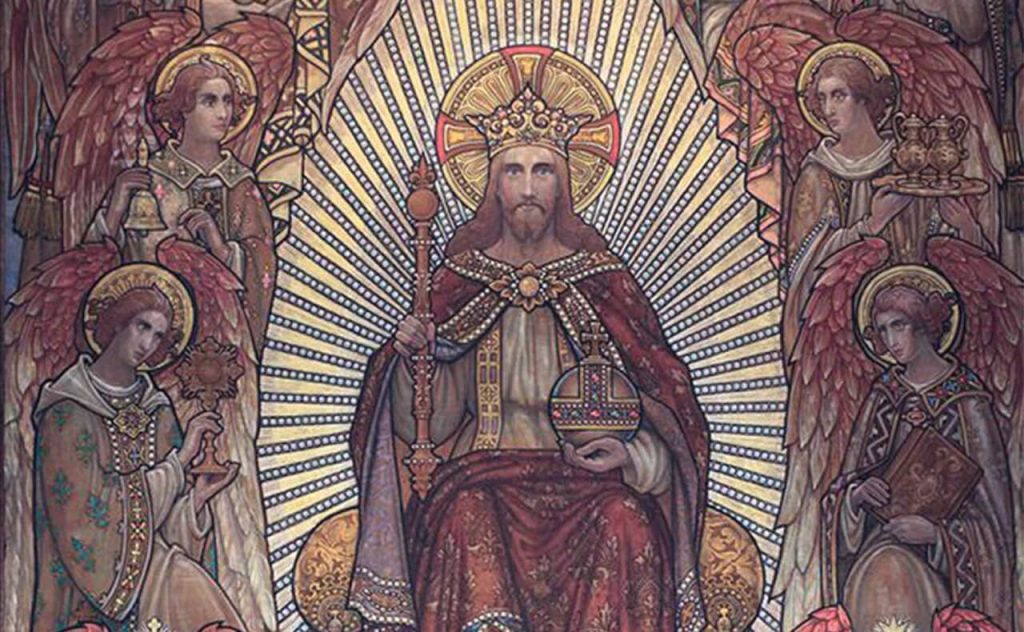
So, Christ is king. We continue to confess that openly, unabashedly, fearlessly, assuring that we will be remembered as Christ comes into the fullness of his kingdom, and so, be with him in paradise.
Amen.