
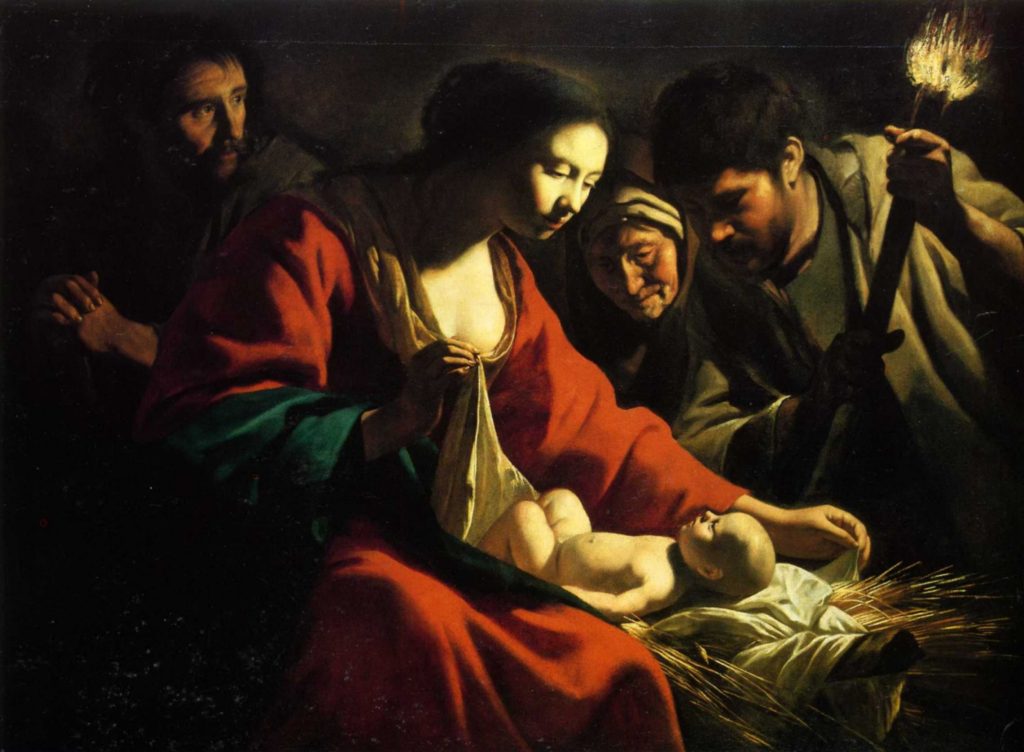
Mass readings for Christmas:
(At night) Isaiah 9.2-4, 6-7 Psalm 96.1-4, 11-13 Titus 2.11-14 Luke 2.1-16
(During the day) Isaiah 52.7-10 Psalm 98.1-6 John 1.1-18 John 1.105, 9-14
Homily (At night)
My wife’s goddaughter was visiting, she’s 3 and a half. For snack time they were watching a Charlie Brown cartoon – and it occurred to me that, she knows the Peanuts, created by Charles Schultz before most of us were even born. Of course, at this time of year, a lot of people will sit down to watch a Charlie Brown Christmas, an animated program first aired in 1965 – the show’s older even than me, and man, I feel pretty old.
It got me thinking about it, and I hope you are all familiar with it because it’s the basis of my comments.
If you know the plot, it’s about how Charlie Brown is so disappointed with Christmas: it’s all so commercial, he complains. Snoopy, his pet dog, decorates his dog house to win a cash prize in a house decorating contest; Charlie’s little sister Sally dictates a letter to Santa in which she asks St. Nick to “please note the size and colour of each item listed” and then ends her letter with, “if it’s all too much trouble, just send money.”
Charlie is looking for something meaningful, and his hopes are raised when he is asked to direct the school Christmas play. But in going to the rehearsal, he discovers everyone is just interested in the attention they will get by being in the play; and they fail to take his direction, to work together, and it all descends into chaos. The kids, however, settle on a solution to their problem – and that is, of all things, to get a Christmas tree to put on stage: that will fix it all. And Charlie goes out to get one with his friend Linus, but that is also pretty discouraging as Charlie and Linus go shopping and come across all these horrible, ugly artificial trees until Charlie finds a real tree. And he’s so happy – here it is, something real, authentic, and, indeed, he thinks he’s found the key to Christmas. It’s kind of like how we all look to traditions, Christmas crackers or the real tree, to give us a Christmas as its supposed to be. Charlie, in triumph, brings the tree he’s found back to the school auditorium, but under the harsh stage lights, everyone, including Charlie sees it for what it is: a pretty pathetic twig. And in despair he asks for someone to tell him what Christmas means.
I think we all at some point in life, or even every Christmas, find ourselves agreeing with Charlie – he’s right! But I daresay he’s actually wrong. Not in the criticisms, but that he’s actually a little stupid in his assessment of Christmas as he experiences it, how we largely still celebrate it sixty years on from when the show first aired. And I mean “stupid” in the sense that like too many of us, he goes for the simple answer to explain it. (So, to the children – don’t go around calling people stupid, because we’re all from time to time “stupid” and need to be loved back into good sense.)
Yes, we have commercialism, and yes, people can be selfish and self-centred. But that’s not Christmas, that’s the world in which Christmas happens. And God, because he desires our freedom as much as he wants our salvation, works with the world as it is, and subtly, but definitely, works, as St. Paul famously wrote, to turn all things to good.
The nativity story that I just read tells us Jesus is born into the Roman Empire. We can generously describe that as a benevolent dictatorship; and, indeed, relative to much of world history, it’s pretty peaceful. That peace comes at a price, an oppressive drive to transform all the territories of that empire into a vast single culture that if anyone cares to study it, was pretty brutal for the overwhelming majority of its inhabitants. And not just brutal in terms of the violence, or the exploitation that occurred, but in the spirituality of it all – it was a world, for all its apparent religion as found in the many pagan temples and sanctuaries, most would experience as hopeless. And for the powerful, that was just fine. Miserable, but hopeless people, are easy to control. So, the gospel was not welcome because it was hope. I like how the British writer C.S. Lewis (the author of the famous Narnia books) put it, the incarnation was like a spy parachuted into enemy territory to lead the local resistance, to carry out little acts of sabotage. And that was the Church for almost four hundred years until that same Roman Empire surrendered and made Christianity legal, and indeed, the foundation of its, and our, civilization.
But in all those long years of persecution, martyrdom, that’s when the Church came to work out its message, refine it, and spread it quietly but effectively through that empire that so conveniently provided the Church with an excellent network of roads, and a Mediterranean Sea that was largely secure and so, a further means of communication and connection across vast distances. And so, the good news spread.
Yes, the shopping malls, and the online stores, the downtowns of towns and cities dress themselves in the season for the sake of marketing, to get us buying. And that has been a pretty powerful thing such that Christmas is celebrated in non-Christian parts of the world. Apparently, in Japan, the whole gift-giving thing was picked up on as a welcome boost to retail sales despite the fact that less than 10 percent of the population is Christian.
But you know, it all creates an opportunity, the possibility of the gospel being heard, the good news of hope breaking through all that noise.
I know a lot of us here work to make Christmas special, to get the gift for another that tells them, in this world, there is someone who remembered you, and essentially, loves you. Think about what all the shopping is about. Unlike most of the commercial activity of the year, when we’re out there getting our needs and wants met in the marketplace – and that’s perfectly alright; for a few weeks it’s not about us, but about others. Christ takes the whole capitalist, consumer machine, constructed as economists tell us on basic selfish human instincts, and turns it on its head. But also, and crucially, at some point in all the busyness of the season, all the chaos of the shopping malls, when once the Christmas feast has been eaten, the presents all opened, in a momentary pause brought on by exhaustion, or too much brandied egg nog, we have that brief time of repose. And maybe, we recall what it’s really all about.
We all know the response to Charlie’s cry of despair, “isn’t there anyone who knows what Christmas is all about?” His friend Linus steps up, walks to the centre of the stage, calls for a spotlight, and recites from the gospel of St. Luke, “…and there were in the same country, shepherds abiding in the fields…”
In a program of roughly 22 minutes, Holy Scripture gets 45 seconds – but it provides the answer.
And you know, way back in 1965, Charles Schultz, the creator of Peanuts, and Charlie Brown, had to fight the television network executives to have that in the show. They were afraid it was “too religious” – for them, they preferred things like Rudolph the Red-nosed Reindeer, and Frosty the Snowman, because it excises all that faith language. But thanks to good old capitalism, consumerism, the incredible popularity of the Peanuts and Charlie Brown, knowing how many people would tune in and what great viewership they would get, the money they would get, they relented. And now, sixty years on, millions of people who won’t be in church, for whatever reason, will get 45 seconds of the gospel, and know what Christmas is all about.
Now, that’s not a complete answer, but it’s one of those seeds we talk about, that gets planted and might just get the water and the sun it needs in due time.
I’m very glad you’re all here, and we’ll have more than 45 seconds of the good news. Indeed, it will be more than just hearing, but it will also be in responding to that message of hope that in these difficult and changing times is so needed. And my prayer is that the response will be personal hope, not just for better years ahead, but also ultimate hope: hope in our salvation, that the love that came down and became incarnate in the Christ child will be found in us, changing us, sustaining us, bringing us not just momentary relief, but an eternal peace in the love of God.
Amen.
Homily (During the day)
As I do almost every Christmas Day at the homily, I will observe that we move from the night time gospel account which is a narrative rooted very much in the real world of shepherds and Roman imperial power, transitioning to the abstract, the philosophical come Christmas Day – the prologue of John, with its poetic weaving of themes rooted in the theology of Israel and Greek philosophy, to force open our minds to consider what has happened in the incarnation; the coming of God in the flesh.
This passage is attributed to the Apostle John, the youngest of the twelve, and it’s believed to have been written in his later years, after many decades reflection concerning just what happened all those years before when he as a youth encountered Jesus of Nazareth. He comes to consider Jesus’ birth, and the role of John the Baptist (another man he knew) in preparing the way for our Lord in his ministry and mission. We know he has heard all those stories that predate his own time with Jesus. As scholars tell us, the gospels that the first Christians knew would have been out of an oral tradition that would gradually, but relatively quickly, be set down in the gospels of Matthew, Mark and Luke. John’s gospel comes almost a generation later, as the old apostle shares his insights as the last of those who knew Jesus in the flesh.
For some of us who had our own introduction to Christ as children, or perhaps, in our youth had a wonderful spurt of religious enthusiasm as we got something more than an inkling as to who Jesus truly is, we’ve hopefully gone through a similar process of deepening and broadening of our understanding of who he is. Or, perhaps more accurately, our sense of his mystery has grown, and we’ve been humbled by that, even as we’ve grown in appreciation, in thanksgiving, for having had that encounter in childhood or youth, and continue to enjoy a relationship, maybe with some pauses in the course of our lifetimes, to this day.
I think about my own youth, and young adulthood, and that sense of really coming into knowledge and understanding, of becoming, I suppose, “adult” in assessing the world around me, its problems, but more importantly, working out the solutions to those problems. I consider that, and then I shake my head at my naivete. I don’t want to accuse myself of arrogance, but there was something of that in my attitude, to be sure. There was also unfounded optimism. And I say, “unfounded” because it was not founded on Christ, even as I was sure I could count myself a Christian – a Christian who no longer worshipped, a Christian who no longer prayed; a Christian who, I must say, did read the Bible from time to time, but not as a means by which to enter the mind of God, and allow the profundity of that to work upon my own feeble mental faculties. No, I read it as one reads literature, as one who seeks a cultural appreciation of texts, how they relate to the history, the development of our own contemporary western culture, as irreligious as it may now be. That is, I was an insufferable intellectual who thought that my thought was important, somewhat unique, and indispensable to the world.
Now, it’s not that our thoughts, our other talents are entirely insignificant. I’m inclined to be generous to all those I count as fellow Christians because we’ve all been growing, at different speeds at different times, and so, I hold back from any such judgment save to remind us all that all the gifts bestowed upon us, the talents given, these only reach their true potential insofar as they are put to the Lord’s service, that they increase his spiritual treasury. We are a light to the world only if enlightened by Christ, and have something of importance to say only if our words testify to his light.
What came into the world is variously characterized as perfect love, holy wisdom, as John puts it, the Logos, the Word, that is the mind or rationality of God; or maybe we can say, the reason for everything became incarnate. We are apt to smirk a little when an evangelical cousin in the faith uses the question “what would Jesus do?” as their moral touchstone, but there’s something to it. Because he is in a very real way, the answer to all the truly important questions.
Why does the universe exist? What answer do we see, know from Jesus?
I was chatting the other day with someone, and guided by the spirit, we came to some profound questions and answers about the point of, well, everything. I observed that for so many intellectuals today, even those who toy with Christianity and the Bible as a source of, well at the most, ancient human wisdom, the universe is ultimately a tragedy. For it will end; and we all end. But as I like to say of the that great material mystery that is all creation, all that we can see, and know of beyond our seeing, that it’s doing something. And when it’s done, we shall see Christ arrive. And I think that what we then might say, in light of Christ’s first coming to reveal to us the meaning of life, of our lives, and in him we see the purpose of everything, then the universe is not a tragic accident, but rather a mechanism, nearly infinite in complexity, that produces redemption, salvation.
We will spend the next liturgical year, this Christmas season, ordinary time, Lent, Easter, Pentecost, more ordinary time, in prayerful examination, but also, I hope joyful celebration of this mystery of our redemption in Christ, through the Holy Spirit, to the glory of God the Father.
Amen.