
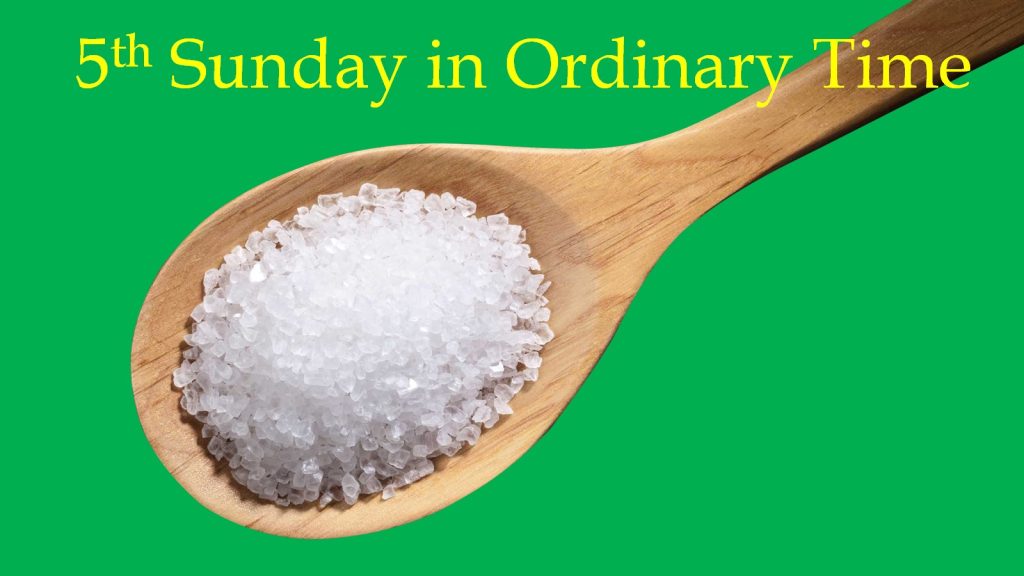
Mass readings for the 5th Sunday in Ordinary Time:
Isaiah 58.6-10 Psalm 112.4-9 1 Corinthians 2.1-5 Matthew 5.13-16
What if salt has lost its taste?
What a curious thought! What a strange experience that would be to pick up a salt shaker, or rip open a salt packet, to shake out salt on one’s french fries, then put one of those hot golden-brown spears of deep-fried potato goodness in one’s mouth to find that it doesn’t taste like anything.
That’s what salt does; I’m sure many of you are quite aware of the chemistry and biology behind it. Salt activates our taste. Even just a pinch of it in the cook pot, in the batter bowl, it actually helps everything in terms of flavour.
It’s also a preservative, used before the days of refrigeration. Since prehistoric times human beings have mined salt, collected it from the sea, and used it to keep meat and fish.
But it’s also something we need even as we crave it. Salt, that is sodium, is part of our body’s chemistry and is required.
But what if salt stopped working? When we hear Jesus speak of saltiness, it’s explicitly in terms of taste, but I believe he’s talking about all its qualities, the one’s I just spoke of. If it doesn’t do what it’s supposed to do, it’s just a useless white powder, but the loss of it also has rather dire consequences!
But let’s focus on how he’s using this analogy. Indeed, who is he speaking to? Who is in danger of losing their essential qualities, that which makes them who they are?
Well, it’s rather obvious. He’s addressing his disciples, but as members of the community that was Israel. And we know from our study of scripture and the history of that time that the spiritual mission of Israel was in peril, and everyone knew it. The authorities in Jerusalem might not have acknowledged it, but we can see in the contending religious and political factions clearly that solutions were bring proposed: among these were the legalistic Pharisees, the politicking Herodians (the sons and daughters of evil Herod the Great), the Zealots who were just beginning to emerge with their plan of war against the Romans. Yet Jesus saw all that was being proposed as wrong-headed and doomed to failure; and of course, we know from history, he was right.
What he proposed then, and through the Church he continues to offer, is the gospel – the good news that sin and death are defeated through him. Focus on that, and all else will begin to fall into place is his argument (of course, there’s more to it than that, his ethic of self-sacrificing love and service, etc.) So, it’s not a political program, nor a legal reform, nor violent revolt. And that’s entirely consistent with what Israel was to be when it was first constituted at Sinai, when Moses gave the law which instructed the people, not just in terms of moral regulation, but also in terms of their spiritual lives through the practice of good religion – they were constituted as a faith community, very much like the Church who today is the new Israel. The old Israel wasn’t to be like the other earthly kingdoms that succeeded through war or commerce or diplomacy (not that these things wouldn’t be part of their life). But it was always very difficult for the people of Israel to understand while other peoples had kings and temples, that the role of the ruler, and the function of religion was to be very different with them. The enterprise wasn’t to accrue power, wealth, or even prestige, but it was to become holy. And by that sanctification, to be a light to the world, that city on the hill, an inspiration that would be transformative for all humanity. In the words of Isaiah, the fulfilment of that mandate would be like the light that breaks forth at dawn.
And the people Jesus spoke to knew that they were far from where they needed to be spiritually. They knew how, with their spiritual lives as a community and as individuals properly ordered, all the other good things came along with it. Again, from Isaiah, there is that promise of healing, but also God’s protection (like a rearguard of an army, a holy people cannot be ambushed).
They knew the stories of King Solomon, before his corruption and fall, when the kingdom of Israel was admired, when tribute came, not from conquest, but from admiring rulers of other lands who were eager to learn from them, to know the secret of their success.
I know that the last many decades have been discouraging; not only in terms of the state of the Church, but also our civilization, of which our country, Canada, is a part. There has been an indisputable moral decline, economic stresses, political strains, and I know that were I to go to Ottawa, visit the provincial premiers in their capitals, jet over to London, to Paris, to Berlin, to see the top officials of those nations with the message that the answer to all their problems is Jesus, I’d get a polite but dismissive response, if I could even get in to see any of those who govern.
And there would be good reason for that dismissal. The Church, again, the New Israel, how’s it been doing? Well, among our separated brothers and sisters of the Protestant mainstream, their past influence and prestige is gone. No one cares what their leadership think or say. The few times they do make the news, the editorial page, its usually to be mocked for their irrelevance and their desperate attempts to gain attention by aping the political activists of our time. I worry when I see our own Catholic hierarchy, and the Holy Father, straying into that sort of thing. Not that the Church hasn’t things to teach, but they are to be rooted in theology, and Thomistic analysis; that is, articulating principles rooted in the teaching of the Apostles and not what some university professor has to say.
It’s hard for us in our current situation as a people to remember our essential role of holding up God, Christ, and the cause of holiness in the midst of the meltdown of the liberal world order put in place after the second world war. There are so many among us alarmed by that, and as many who believe it’s about time it came to an end. So, we have progressives pitted against populists, liberals contending with traditionalists, those who cling to the postwar institutions despite their failings and those who want to burn it all down. And in viewing that from a theological, biblical perspective, I can’t help but conclude we have returned to that place where the old Israel found herself in the first century: the nation politically shattered into different jurisdictions and today, Christianity exists in schism; like the diaspora of the Jews that had more of them living outside the Holy Land than within it, more Christians, at least those who call themselves Christian, are outside the Church in the sense they do not come to worship services, study the scriptures within community, nor act in service through their churches; and frankly, they have been largely absorbed into the secular world – their moral behaviour conforming to the world far more than to the teaching of Christ.
Now, I have shared encouraging news in past homilies of a real, though modest, revival within the Catholic Church. The disillusioned looking for answers, indeed, looking for God who is the answer, have come looking here. And while a great many remain within their comforting illusions, many young people see the reality of their situation and are dispensing with the secular pieties they’ve been instructed in through their schooling, the culture and the media. But when they come to the Church, is she found to be salty, or is it bland tastelessness they find?
We’ll be talking about where this parish goes in the coming years, and that’s a conversation that will be facilitated, by our own auxiliary bishop, Wayne Lobsinger. The question is out there: how do we get salty? And I’m well aware that being “salty” in popular slang means to be bitter, resentful. So, that’s not what we’re after. No, we want to reclaim that word, and make it synonymous with savour, flavour, a life of meaning, joy, confidence and peace; even to have it associated with light. I actually have a salt light on my desk, a big hunk of crystal that glows when, well, when I think to turn it on. Now, is the time to turn it on, to activate the light within us, look around and see how we can be salt, and light, dispelling gloom and restoring life’s flavour.
Amen.