
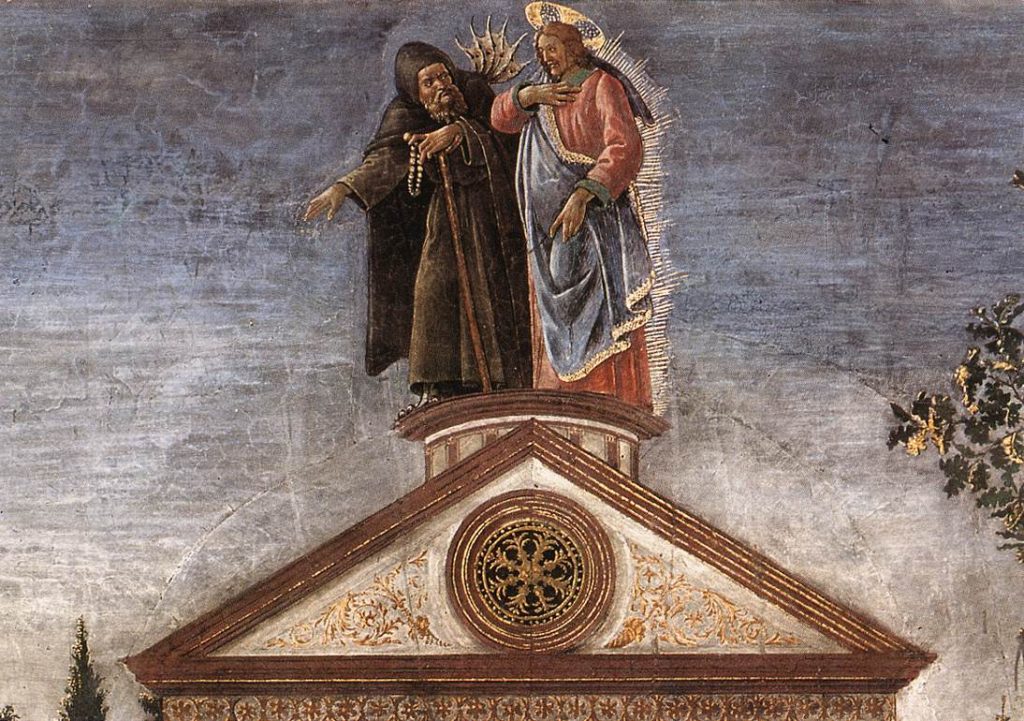
Mass readings for the First Sunday of Lent:
Genesis 2.7-9. 16-18, 25; 3.1-7 Psalm 51.1-4a, 10-12, 15 Romans 5.12-19 Matthew 4.1-11
Today we hear the story of Christ’s tempting by Satan; the famous three temptations: to satisfy his hunger at the end of a long fast by turning stone to bread; to demonstrate his confidence in God the Father by throwing himself from the pinnacle of the Temple in Jerusalem – the reasonable assumption that God will not allow his anointed to die before he can begin his work. Lastly, Jesus resists the offer of dominion over the Earth in exchange for worshiping Satan – he will not put the world right through worldly power, but rather save it by humanity’s free acceptance of the Gospel.
For the disciple of Christ these are important principles. We must not act according to our fear of or experience of material scarcity; and by faith we are freed from that.
The truth of the gospel is not verified by miracles but in a deeper, profound knowledge of God in our relationship with Christ through the Holy Spirit.
We cannot exchange divine love for worldly power to fulfil Christ’s mandate. As Pope Saint John Paul II famously said in the encyclical Redemptoris Missio (Mission of the Redeemer), 39, “The Church proposes; she imposes nothing.” Salvation by invitation to all.
We are sustained in our faith despite all these things we must deny – we are sustained by the truth of Christ, and that was one of the great themes of St. John Paul II’s papacy “you will know the truth, and the truth will set you free.”
And that’s an important message to hear at this time, when we will have people, not just in our diocese, but around the world, being presented at the Rite of Election, and so, enrolled to be baptized at Easter, joined to Christ in his Church. There will also be those already baptized who seek to enter into full communion with the Church. What is on offer? The truth – but is that enough? Freedom, but do we really want that?
I’ve been reading The Brothers Karamazov by Fyodor Dostoevsky – I’ve never read it. But in recent years I’ve seen repeatedly the assertion that it’s the greatest novel ever written. So, I got a copy, I’m reading it, but I haven’t finished – so, nobody tell me how it ends!
I mention this is because one other reason the novel is so recommended is that within it there is a chapter entitled, “The Grand Inquisitor” and this is where one of the Karamazov brothers, Ivan, a religious skeptic, tells his young brother, Alyosha, a parable to explain his lack of faith; central to that parable is a critique of Jesus’ refusal to give in to Satan’s temptations. The argument is, he should have and made everything so much easier for us.
The story is basically this: Jesus comes back to Earth in the time and place of the notorious Spanish Inquisition. This is when all sorts of abuses were being carried out by a regime that was effectively a fusion of both civil and religious authority. The authorities arrest Jesus, and the Grand Inquisitor comes to, well not so much question him, as lecture him: Jesus, why have you come to interfere with us?
And the criticism is that the temptations, and Jesus’ successful resistance lays down the principles of a Christian discipleship that is impossible for any but the greatest spiritual athletes to pursue. The inquisitor admits that perhaps a few thousand have been saved – among these are the famous saints who fill up our Church calendar; but many more millions have fallen, and will fall, well short of heaven. Jesus, the inquisitor says, gives human beings too much credit – our fears and desires have a much stronger hold on us that our Lord realizes. As rebellious as we may be toward God, we are willing slaves to our vices.
And the Grand Inquisitor asks, in so many words, what kind of deal is it to suffer hunger, persecution (often violent), the frustration of a world that will not listen to the gospel, in exchange for… well, what? A vague kind of inner peace, a consolation, and yes, eternal life, but that’s something the inquisitor argues again few will attain. And so, speaking on behalf of the Church specifically, but I would argue, the ruling class more generally, he says that they’ve shown far more love and concern for people by what they’ve done to compensate for the impossibility of authentic Christian life.
The inquisitor’s assertion is that the vast majority of humanity will never really embrace Christianity. Indeed, even among those who call themselves Christian, almost none truly live the faith, responding to the call to ‘take up the cross’ and follow our Lord.
The inquisitor puts it to Jesus that he and others in the leadership of society, both ecclesiastical and civil, nonetheless recognize that Christ has died for us. So, they emulate Christ by the sacrifice of their lives in organizing for the people compensations for their inevitable failure; to give them some comfort in this mortal life, some hope, albeit false and illusory, so they might die in peace.
The Church’s charity is a manner of feeding, and it encourages the civil authorities to do likewise – and so, we have at different times and places some kind of social welfare. As to miracles, the Inquisitor says, that’s harder to pull off, but we do give people mysteries. That is, sacraments that are in themselves, miraculous, if you believe what the Church teaches about them. And while the eucharist doesn’t cure my cancer, I can contemplate with deep fascination the mystery of transubstantiation.
And lastly, power. Well, here it’s time for something of a substitute, not sugar but saccharine. And what I infer from the parable, is that it is the Church’s influence, her “soft” power, participation in worldly power to the benefit of the masses, that the temptation to power that Christ refused is satisfied to some degree.
Dostoevsky was a man of Christian faith, and he’s clearly giving us a very cynical take that we’re familiar with. The person of faith reading it will know the faults of the parable. I worry that those no longer raised in faith will actually read this and be convinced it’s true! What the brother who tells the parable forgets is the power of God’s grace to perfect us, and he is too dismissive of the peace of God that passes all understanding to be, not a mere consolation, but indeed a very real reward for the person of faith.
This is Dostoevsky’s lament: too many people do, indeed, give up on their Christian faith, and settle for something that will be described by later theologians as “cheap grace.” That is, the faith as mere sentimentality, or in some instances, smug self-assurance that one is simply a better person for acknowledging Christ while never really following him beyond what social norms expect. And you know, you don’t need to go to mass then; just wear a crucifix, sling a rosary over the car’s rear-view mirror and maybe have a statue of our Lady somewhere in the house – one surrounds oneself with signs of that acknowledgement without bothering with it, especially while living the comfortable life that has been Western Civilization. And to be clear, being the nominal Christian is usually being a law-abiding, tax-paying member of the community, who loves his kids, is friendly to neighbours, gives to charities collecting at the shops, maybe sponsors a child overseas, does the cancer fun run, and generally, fits into a society that really wants him to keep to that, conforming and so, comfortable. This kind of Christian has bread, the miracle of technology, and while such wouldn’t understand themselves as worshiping worldly, satanic power, they defer to it, admire it, and in the form of celebrity, some practice devotions to singers, athletes, etc. as we would to a saint.
And it’s all fine, until it isn’t. The depth of a spiritual crisis is usually determined by one’s preparations or lack of them; by the degree to which one lives in the truth, or opts for fantasies. And the crises will come.
I noticed the Globe and Mail running a story last week about Canada’s economic plunge of the last decade. We are less prosperous than Alabama! The story noted that when times were still relatively good, our dollar worth $1.10 U.S. the government in 2007 commissioned a report on our economic future. It stated that while things were indeed good, serious challenges could be seen coming. The problem, as the report concluded was “Canadians do not perceive that there is an imminent crisis” nor were they prepared to listen to warnings about it.
Every Lent the Church warns, but also reassures. Yes, the challenges to us are real, and the call of Christ to take up the cross is a difficult one to respond to. But by grace, the Holy Spirit flowing through the community of the faithful, and so, to each one of us, we can take up that cross, and journey with our Saviour. We can go through the wilderness, up towering heights and into deep, dark valleys, all in worship and service of our God. And we’ll make it; and then, indeed, the angels will wait on us.
Amen.