
Mass readings for the 3rd Sunday in Lent:
Exodus 17.3-7 Psalm 95.1-2, 6-7, 9 Romans 5.1-2, 5-8 John 4.5-42
Today’s gospel is an excellent example of how we ought to engage people in a discussion of faith – and I say this because it cuts through a great deal of what makes conversations with people of other faiths, or those who have particular ideological commitments, so fraught and difficult. What we see and hear Jesus do is that he simply speaks to the person’s spiritual need without great regard to their own religious or philosophical challenges to him. That’s where the gospel connects to people; that’s when God can speak to their hearts, and then to their minds. The convincing doesn’t come through argument, but in reflection upon what we offer in witness to Christ, it comes not from bullying someone into agreement, but in offering them the truth about ourselves, about them and humanity more generally, and letting them contend, not with you, but with that.
What is convincing about the gospel then, is not that we as Christians can out-argue, out debate any challenge from either another religion or from someone of a secular perspective – those debates have their place. It’s simply more important that we offer the truth; we invite people to consider this in light of their own personal experiences quite apart from whatever it is they hold as a belief system. We leave it to them, and pray that by grace they will come to the answer we all at some point came to; an answer that was in fact a person: Jesus Christ.
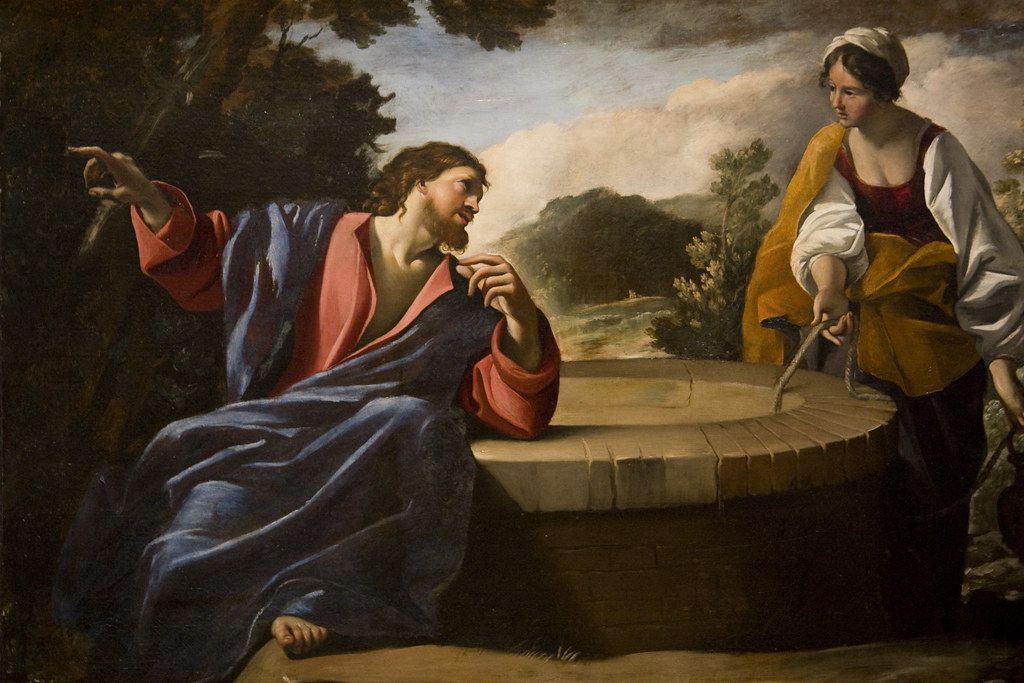
In the story of the woman at the well, we are told a few things about her both directly and indirectly: she’s a Samaritan, not a Jew, nor a pagan; she is socially isolated as is evident from the fact that she has come to the well in the heat of the day instead of in the cool of the early morning along with the rest of the women of the village; we hear from her that she has a pretty good grasp of her own religion and its traditions. That is, she is not indifferent to these things. Indeed, these likely trouble her in light of her circumstances – she belongs to, and yet no longer fits into, the Samaritan religious community.
In her miserable situation, she has hardened. When Jesus asks for a drink of water, what he gets is hostility. But he knows why she’s that way – this is what she likely receives from her own people, coldness of attitude. She rhetorically pushes him away by calling him “a Jew.” That is, she reduces him to that single dimension of his identity. And boy, don’t we see a lot of that today – being defined based on race, gender, or some other immutable part of ourselves, and not on who we actually are as individuals.
I don’t know how the woman heard Jesus’ request for water, what his exact tone was, but we see her taking it in the worst possible way and then putting up a wall in saying, I’m a Samaritan and you’re a Jew.
That’s a pretty high wall too. We know from scripture that there was considerable enmity between Jews and Samaritans. In large part because Samaritans, to be quite accurate about it, had taken the Hebrew scriptures, the traditions related to the worship of the God of Abraham, Isaac and Jacob, and distorted them under the influence of foreign cultures and religions. They transposed, as we hear in the dialogue, the location of the holy mountain from Zion to Gerizim. Now, if there are any Samaritans here to today, forgive my bluntness in this, but it’s hard not to see from history, archaeology, theology, that this isn’t what happened. Jews had a legitimate bone to pick with their neighbours and religious cousins.
Further to this, recent research indicates that the Roman Empire actively recruited Samaritans to serve in their army as auxiliary troops, and that they were deployed in Judea and in Jerusalem. So, Jews would have seen Samaritans as willing servants of the oppressive, pagan Empire by whom they found themselves dominated. In turn, the Samaritans would have been sorely tempted to lord their position as the effective police force over the Jews.
Today, the reality for us, as Catholics, for the Christian majority in Canada is that we are caught between two rather powerfully invasive belief systems that seek to supplant our civilization, and replace it with their own.
One is secularism which dominates our institutions and government bureaucracies. To be accurate, it’s a post-Christian secularism that selects from the Christian heritage what it will of morality, of spirituality, while disavowing the source. It’s a belief system, a faith, that refuses to recognize the confusion and contradictions that come of trying to live a heavily edited version of Christianity, especially one that has edited out Jesus Christ.
On the other side of this, we have, to be frank, Islam. And historically, the Catholic Church has described this as a heresy. It not only denies Christ, but the Quran, supposedly the word of God, misunderstands what Christians believe. Now, one might argue that God isn’t pleased with what we believe, but I think God would nonetheless have an accurate picture of the substance of the Christian creed. The text also takes many of the stories of the Bible we would be familiar with, and changes them claiming to have corrected them. And those changes are not insignificant in that they recast the history of salvation in a way that makes Jews irredeemable villains, and Christians, their unwitting, ignorant dupes.
There are those who think that the approach then is to argue with secular people, with Muslims, on such a basis: to prove them wrong, mistaken, contradictory and confused. And while I’d say, yes, they are; I know that such an approach gets another’s back up, and what we say in such a vein become “fighting words.”
And besides, the comeback from the secular person is that we can offer no proof that our invisible god is real. For the Muslim apologist, it’s simply that our Bible is wrong, our sources corrupted and incomplete, and that they have the accurate information no matter how flawed it so obviously is. The argument is a stalemate.
The approach of Christ is to look into the suffering of the other, and speak to them of relief, to recognize their thirst and give them the cup of refreshing kindness they so need – but, indeed, to do so in the name of Christ.
Is the godless way of life working out for people? Do other religious systems satisfy the spiritual instinct to ground meaning in a belief system, no matter how bizarre? Well, some people will indeed say, “I am happy with what I have.” They believe they possess already what we have to offer, truly, what Christ has to offer.
But so was the case with the woman at the well. So, was my case; so was, I’m sure, the case of many who now call themselves Christian. Whatever well we were drawing from to slake our thirst for meaning, for explanation, for direction in life, it went dry.
And we’re seeing more of this in recent times: while so many cradle Catholics and Christians from childhood, fall away, for the most part convinced by the promises of modernity founded on secular myths, there are those who having had little or no religious upbringing who have come to see, hear, and indeed experience something in Christ that prompts them to ask questions, and have conversations such as we read and hear about today. For those of other creeds who find water here and there in their faith, but are parched for so much of the time, they too search, and we know that from the internet search statistics from such places like Iran and Pakistan. They are asking questions too, in the safety of online anonymity, but they’re doing it.
And so, for us today, those who will come to the baptismal font at Easter, the wellspring of graces, those of us who were long ago bathed in it, it’s for us to keep coming to the well, to draw not just for ourselves, but to draw out the cooling waters of grace to offer to others, those parched and thirsting on the road of life today.
Amen.