Mass readings for the 4th Sunday of Easter:
Acts 2.14a, 36b-41 Psalm 23.1-6 1 Peter 2.20b-25 John 10.1-10
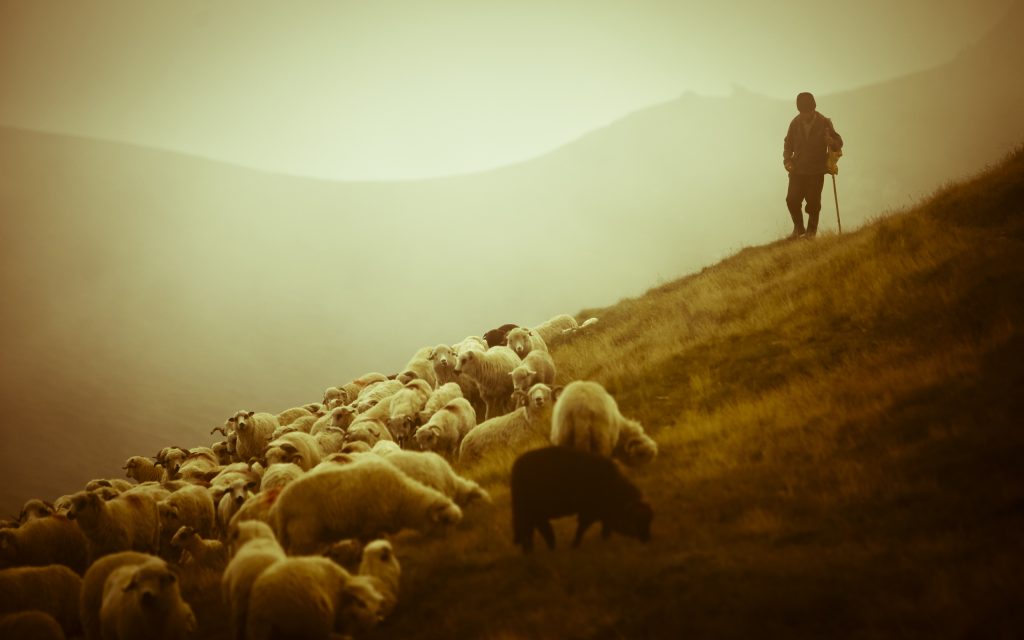
In the cycle of Easter celebrations, we come to today’s that features gospel passages where Jesus likens himself to a shepherd, us to sheep. We see in these verses from John, he also speaks of himself also as the gate of the sheepfold, the secure enclosure into which sheep are gathered at day’s end to keep them safe from the predators of the night. It’s a comforting metaphor of our relationship to our saviour. From personal experience helping a sheep farmer friend, I can say how apt it is. Sheep frighten easily, as they are very vulnerable. They are also suspicious, and really do bond with their legitimate keepers, the shepherd whose flock it is, and not to hired hands do they give their trust.
Among the familiar words we hear today are those that tell us that the sheep know the voice of the Good Shepherd. And so, we must ask, how well we (who are the sheep) know his voice, and how we might know it better. There are many voices being heard these days, many that are misleading, that carry us off in directions away from the care of the Good Shepherd, and make us prey to the wolves of this world.
Now we might presume to know whose voices to trust: the priest at the ambo preaching, the bishop on his throne teaching, the Pope on his balcony addressing the crowds, but even members of the laity, known for their faith and piety, can speak and our Lord heard in what they have to say. But even with these we must be careful. As much as I try, by prayer, by attention to my words, we need to remember I can err, I can be confusingly ambiguous, and I can let my own unconscious biases creep in. I do try to correct this when I see it. My task in preaching and teaching is to pass on the principles of our faith; and that’s what we should be listening for.
I recall most definitely what I was taught by my instructor in homiletics at St. Paul University in Ottawa. In the liturgy, the homily is not the high point, not even close. The mass has two summits, two great heights to which it ascends spiritually taking us with it. The first, but lesser of the two, is the proclamation of the gospel. These are the very words of Jesus. Whatever the preacher says after cannot be but less than what our Lord has said no matter how brilliant – not even the greats like St. John Chrysostom or St. Francis can compare. The second and greatest height is achieved in the Eucharistic celebration, and in particular, in the receiving of the Blessed Sacrament (something that will happen for the first time at two of our masses this weekend) – the act of communion where we physically encounter our Lord, and even more profoundly receive him into ourselves. We eat of his flesh and that is then incorporated into us. No priest, no matter how beautifully he celebrates the mass, can equal that moment.
The word of God is eternal, it is universal. As Jesus tells us, it will not pass away even as heaven and earth will pass away in the coming new creation. And so, whenever there is teaching on a principle, that is universally applicable, it is not just applied to our enemies – it applies to us as well.
These are what bind us together in Christ, bring us into the sheepfold, keep us safe.
Yet there are diabolical forces at work in the world that seek to set us against each other, and to have us abandon the sheepfold. They imitate the voice of the Good Shepherd, and manipulate the messages of the Church and her leaders to give the appearance of greater conflict than there is around real differences that do exist.
It was disturbing to see the two most powerful men in the world set against each other, the U.S. President and the Holy Father. And while each have their admirers and detractors, we need to be aware that much of what happened in recent days came of misunderstanding, misconstrued public statements, and reporting that imposed interpretations on what the Pope said that the context of his remarks didn’t really support. This is all to say, we need to be careful in our reactions to this sort of thing, not let our own biases get in the way of hearing what God who knows no partiality is saying in the midst of it all. Yet we should know what Pope Leo said, and understand its importance: the subject of just war isn’t to be avoided because it is difficult, rather we must as moral beings engage the subject and have substantive discussions as nations, societies, as a civilization. The Catholic tradition regarding just war, from our own St. Augustine, through its elaboration by St. Thomas Aquinas, down to today, is a rich resource for this important ethical discussion of how we defend ourselves as a people against those who seek our national and cultural destruction.
Pope Leo was quoted as condemning those who wage war, saying their prayers are not heard by God. He was preaching from a text from the prophet Isaiah, “Even though you make many prayers, I will not listen: your hands are full of blood” (Is 1:15) The unrighteous, the sinful, cannot please God by waging war in his name.
The mischievous interpretation put on it by many in the media is that this was aimed at just one person: the U.S. President.
Yet we know something of Pope Leo as a spiritual leader who does not work by crass personal confrontation, and this homily given on Palm Sunday was directed at the general situation in the world. Our receiving of his words should be informed by the Holy Father’s efforts of late to tamp down conflicts between Muslim majority populations and their Christian minorities – his recent foreign visits very much about that. So, his address should be taken as being directed to Catholics and beyond the Catholic audience, to non-Catholic Christians, but also Muslims whose own Quranic tradition endorses violence in the name of God, and regards the destruction of non-believers as virtuous.
That is, if we are listening to hear Christ in the words of our spiritual leaders, especially the Vicar of Christ, the Pope, the discernment should be in how the words are universal, eternal, consistent with what the Church has always taught and so, not aimed at anyone in particular even as they help us assess specific situations of our times. The Holy Father is not picking fights, especially ones that will not serve to advance the Church’s mission. What the Pope said is applicable to the Iranian mullahs who conspire to build nuclear weapons and who slaughter their own people by the thousands because they protest, to the Syrian jihadists who have seized power in Damascus and unleashed violent persecution on religious minorities, and of course, to western leaders like the U.S. president, who do need to justify their military actions.
We are Christ’s, and we listen for him past all the noise of the world, harkening to the truth, pursuing justice, advocating mercy. In Christ there is no deceit, St. Peter reminds us. So, we should strive to not be deceived. And we won’t be if we feed our minds with the Word of God, and our souls with the imperishable bread of life.
Amen.