Mass readings for the 6th Sunday of Easter:
Acts 8.5-8, 14-17 Psalm 66.1-7, 16, 20 1 Peter 3.15-18 John 14.15-21
In the first reading we return to the Book of Acts, that earliest of Church histories that appears in our Bibles. Last week we saw the Apostles overwhelmed by the numbers coming to Christ such that they needed help, and so, appointed the first seven deacons, and established that as an ordained office of the Church. Today we read about the Church experiencing organized persecutions, and now its leadership is dispersed and some are in hiding. Philip, one of the new deacons, leaves Jerusalem and makes his way to Samaria. Given license by the Apostles to preach and teach, he does so, and now creates a new problem, but a welcome challenge – there are now believers in Christ among the Samaritans. So, the issue is geography, and the question is how does the Church bind herself together as one body, the body of Christ in the world across space. We might think nothing of the distance between Jerusalem and Samaria today – Israel has modern roads, and we can drive from the city to Mt. Gerizim in a few hours. Back in the days of the Apostles though, that’s a two-day hike. The Roman Empire had vastly more resources in terms of time, personnel and money, and they struggled to establish and maintain control over their provinces. How then could an organization, with little wealth, and with leaders whose lives hitherto had never involved guiding such a large and now widely spread community, hope to manage?
So, as with last week’s story of the deacons establishing for us the foundational principle of service in the Church, today we see emphasized the need for the ministry of Apostolic authority to hold together a Church that spans the world. And that isn’t mere human authority, because by all evidence of history, it never should have worked. The office of Apostle, and its successor, the Bishop, is wholly dependent upon the Holy Spirit; and in turn then, so is the whole of the Church. This is the only way to account for how we have overcome the deficiencies we have as human beings to have and keep a Church now for two thousand years! And so, we as individuals are only truly in and of the Church when we abide in that Holy Spirit, keeping Christ’s commands so that, indeed, the Advocate remains with us. What keeps us abiding in Christ’s love is the ministry of the bishops, their keeping of the Apostolic traditions through teaching and preaching, but most of all through the power of the Holy Spirit most especially manifest in the sacraments.
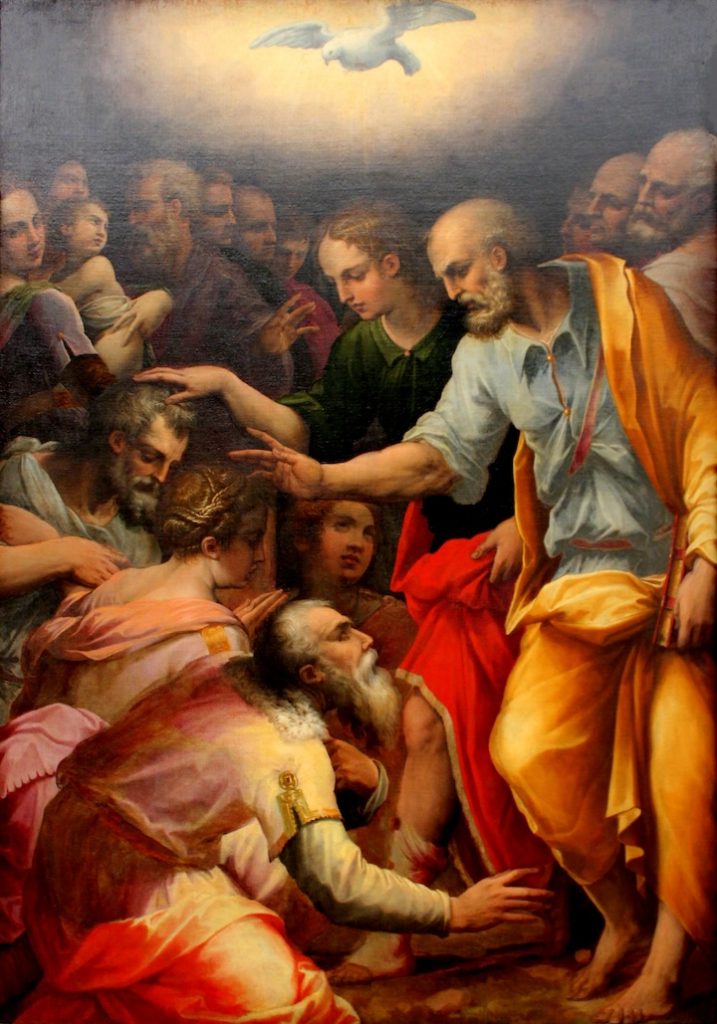
If you were paying attention to the story from Acts, it can’t escape notice that it looks like Philip the deacon baptized Samaritans, but it was then seen as necessary for the apostles Peter and John to go, and well, confirm them. And so, we have a strong indication that it’s not just that we need an overseeing authority to ensure the teaching is correct and the preaching orthodox, but we need the mystery of the sacraments, the means by which we receive the Holy Spirit as a community of believers; and the sacraments properly belong to the ministry of the bishops – as a priest I am deputized to the bishop for the purpose of making them available to as many as possible.
Now, the Church does not control the Holy Spirit, but she has been given sacraments as an assured means to confer the Spirit. That is, if I consecrate the Eucharist validly, we know with certainty that in consecration the bread and wine become the body and blood, soul and divinity of our Saviour; the waters of Baptism are truly a means of grace that has a child or adult washed, not just with water, but cleansed of original sin by the Holy Spirit, and so on. However, the Spirit goes where he wills, and people will have their experiences of the Holy Spirit quite apart from the sacraments. We have the testimony of the saints as proof: Teresa of Avila, Francis of Assisi, Faustina, Padre Pio. All these had experiences, ecstasies, through the power of the Holy Spirit.
The important thing to remember for us, is that it is in the Church that we find the means, by sacrament, and by right prayer and attention to God’s word, to open ourselves, surrender ourselves to the ministrations of the Spirit. And while we enter into this sacramental life through baptism and confirmation, we have need to constantly renew it through regular communion, repair it through confession, revive it in times of distress through anointing, rely on it in the sacraments of marriage, and of Holy Orders.
Why do some Catholics claim to find nothing then in the sacraments? It’s because they stop receiving them. They don’t incorporate into their lives that which progressively incorporates them into Christ. These mysteries lead us on the way of Christ, nourish us, provide food for that journey, fuel for the engine of faith, water to keep evergreen the hope planted within us.
To forsake the Church and the sacraments, even informally, and so, not by some dramatic renunciation of faith, but by a simple halting of its practice, well, it’s like learning to drive, buying the car and never driving it, letting the gas go stale in the tank, and then wondering why it won’t start Easter morning when we’re anxious to get our visiting grandmother to mass.
But you know, they’ve got this stuff you can put in the tank to pep up the gasoline, get the car started and running well enough to get to a filling station for some fresh fuel. And it is our bishops who keep the system of parishes properly ordered and ready to fill us up with the Holy Spirit. That fuel reviver of my metaphor, well, that’s the grace of God.
Now, I do lament that our bishops don’t make it around to the parishes as often as I would want. The challenge is of finding time, but also the means to cover the territory of our diocese that stretches all the way up to Tobermory. And it’s my hope that the current practice of confirmations with bishops only one in three years in a parish is changed so that our children in receiving that sacrament are reminded of how the Church is not just the local parish, but a network of local communities—I checked, it would take you five full days to walk to the tip of the Bruch Peninsula—but even beyond that, something that stretches around the world. And in keeping with that, I hope there are among our “under 30s” in our parish some who will give consideration to going to the World Youth Day in Korea next year. To have them then return and give testimony to the power of the Holy Spirit to work through the successors of the Apostles, and create a Church that spans the whole world, encompasses 1.4 billion members, and yet can minister to each one of us as individuals, beloved of a God who knows us and loves us.
Amen.