Mass reading for the Solemnity of the Ascension of the Lord:
Acts 1.1-11 Psalm 47.1-2, 5-8 Ephesians 1.17-23 Matthew 28.16-20
Do any of us enjoy fear and doubt? Uncertainty? Do we like not knowing, not knowing what to think, feel, do, and then fear the consequences of our inaction?
If the answer that came to mind was “No, of course not.” I’ll challenge that, and observe that the number one genre in cinema that almost always makes money, sells the tickets, is horror. A lot of people enjoy being scared. Personally, I prefer suspense films, that gives me the shocks without so much blood and gore.
And when it comes to doubt, a favorite and one of the most effective openings for a public or university lecturer is to start with a question that challenges our assumptions – like I just did a moment ago. It piques our curiousity, it stimulates the mind – and it is good to revisit our assumptions from time to time, to test them, and make certain our belief is grounded in reason guided by grace and our manner of life consistent with that belief.
But we all recognize that in both those instances, it’s not something that is constant, and in any sense “real” but really something simulated that excites and entertains us. Having experienced real fear, I know I don’t enjoy that; and doubt… well, that is something that isn’t quite as urgent and immediate as fear, yet to live with it is a constant stress. So, most people try to remove it from their minds by distraction, or more worryingly, they commit to beliefs in a decidedly irrational, emotional way so as to alleviate their anxieties.
Fear and doubt are dominant in our secular culture. Fear is stoked in the mainstream media – now that may be inadvertent, simply the product of needing to keep people watching. So, the news is made into a compelling stream of threats to our safety and security; or less so, it stories are presented that tap into our social anxieties of being out of step with fashion, with popular opinion, and so, not belonging. Inadvertent, but also these could be the product of more sinister forces (after all, Jesus makes regular reference to the prince or ruler of the world, as his adversary, Satan).
And doubt, well that is the sine qua non of our civilization now, a society in profound crisis, unsure of itself, questioning its history, its future, and at the heart of it, questioning its legitimacy: are we the good guys? The surest way to undermine institutions, like the Church herself, is to initiate a process of questioning that will not end until what was has been is no longer, what was raised up is brought down, what was built is in ruins. And so, it’s little wonder that we have a divided society wherein half are engaged in the tearing down of our society for its sins, and the other half in restoration and renewal of what we can plainly see as the good of our Christian heritage.
But how do we know what needs to be condemned, and what needs to be saved? Were this a matter of this church building falling apart, what would we do? We could have a meeting where we gather, having no particular expertise or experience with heritage buildings, and then talk about whether or not it’s worth keeping it in the first place; whether we would be better tearing it down and making a park for the local community, or some other public amenity. That would express our doubt about our mandate from Christ to build his church, it would manifest our fear that the gospel will be rejected, and so, we try to find something more appealing to people, that would make them think well of us. Or, we bring in the experts, the architectural historian, the general contractor and the specialist trades; and they would evaluate this place and tell us what needs to be done. We’d speak with missionaries and evangelists who could guide us, based on their experience, in the ways of building up the Christian community that would make the church and its facilities successful as a place of faith. And we would listen to them because of their authority; confident they know what they are talking about. But, of course, we’d test all that they say against the guidance of the Holy Spirit in prayer, in the words of our Lord in study. And why do that?
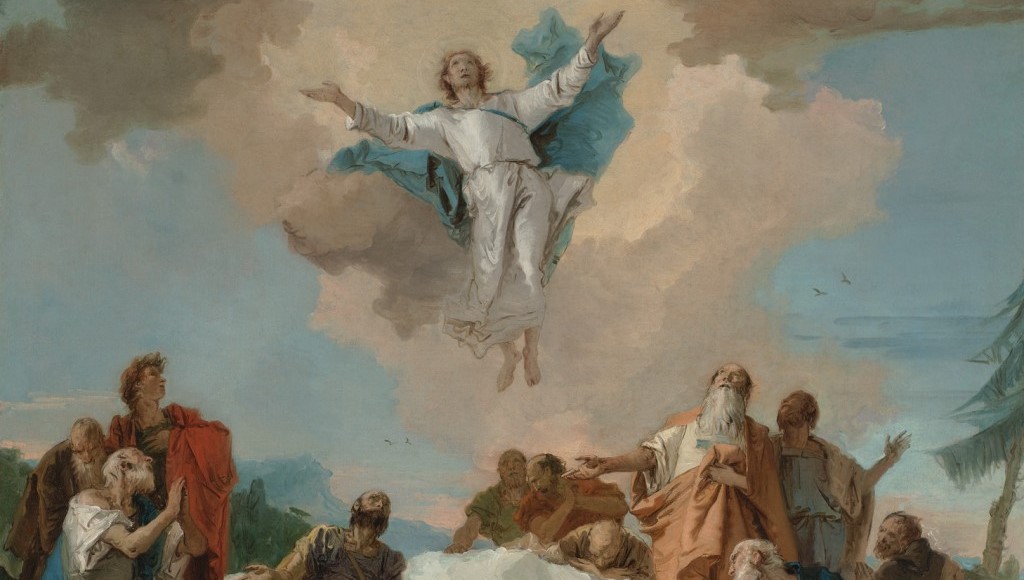
Today, in our celebration of the Ascension of Christ, we hear our Lord and saviour declare, “All authority in heaven and on earth has been given to me.” And we regard this as an authoritative statement with respect to what has been given to us in the Catholic and Apostolic tradition that has come from Him. Within the Church, Christ is the ultimate authority; no one may contradict him, undermine him, subvert him, in his authority and remain a faithful member of the Church enjoying the fruits of redemption, the freedom of the saved in Christ.
It’s because of that authority that the Church can speak with confidence, even in the face of a hostile world. We can affirm the dignity of human life, uphold the centrality of the family according to the models of faith we have in our Lord, in our Lady, in Blessed St. Joseph; the Holy Family. Such authority allows us to preach and teach on moral questions and ethical controversies, but it also allows us to offer a blessed assurance to the faithful – yes, God is with us, with you. He is found in word and sacrament, and indeed, as we grow in faith, we come to find him everywhere: in our joys and our sorrows, in ourselves and in others.
When synodality, that initiative of a few years ago now, was introduced as means of engagement within the Church, understandable worries arose, and in some instances were confirmed. Indeed, some of the synod’s working groups engage in discussions, and publish reports that are in that secular vein of doubt, and out of “pastoral” concern, elevate naïve empathy over hard-won wisdom, and launch into seemingly interminable conversation over settled matters of doctrine that erodes confidence in church teaching and exhausts the faithful.
Of course, synodality can function in a fruitful way: the faithful understanding of synodality, and the one I believe the Church actually embraced, is that of seeing value in discussions of how we can better communicate the good news of Jesus Christ, and the be truly his Church who represent him by living out the gospel, both as a community and as individuals. It’s about the Pope and the bishops serving as they were mandated to do: stewards of the Apostolic faith. But in fulfilling that, they walk with the rest of the Church, journey with her, and not above her, or beyond her, and they listen to the concerns, but also have an ear out for the celebration of our faith so as to gauge what they must bring forth from the great treasury of our faith to meet the present need. As much as the bishops are the keepers of the Church’s teaching, they also guard and pass on her sacraments, gifts of Christ given through the power of the Holy Spirit through them to us all. And as our Lord tells us today, it is through that power that we can be Christ’s witnesses to the ends of the earth.
And this is to be translated down to the parish level as communities of the faithful engage as a family of faith in the work of ministry, confident in the message we have to share, assured of the sacraments as given by their priests, to be in possession of, as St. Paul puts it, “a spirit of wisdom and revelation” that we may know Christ and “with eyes of our hearts enlightened” we may truly know the hope to which our Lord has called us.
Amen.